
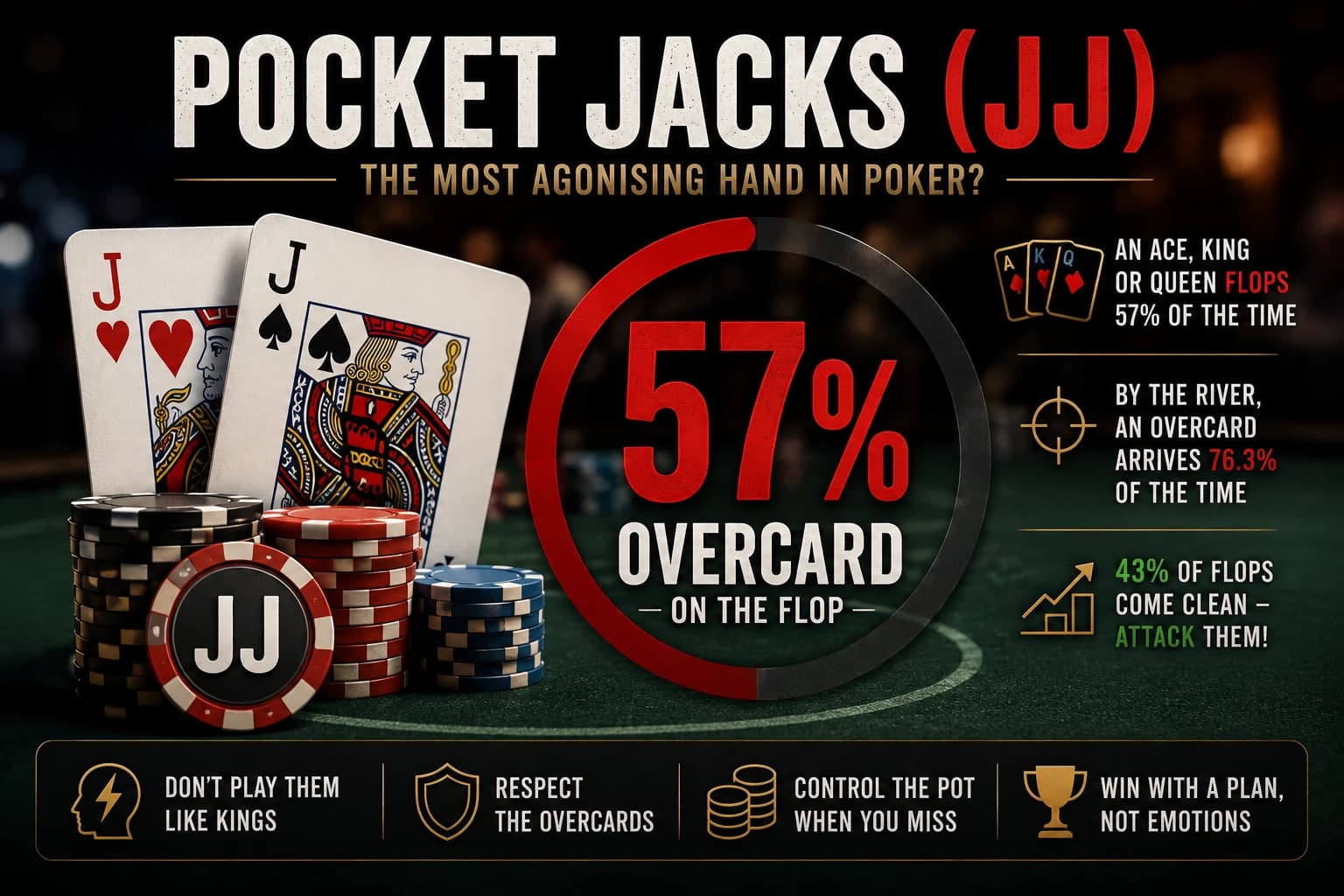
Few hands in Texas Hold'em cause as much grief as pocket jacks (JJ). On paper it is the fourth-best starting hand in the game, behind only pocket aces, kings and queens. In practice, players lose more chips with jacks than almost any other premium holding — not because the hand is weak, but because it is so easy to misplay.
Why pocket jacks are so awkward
The core of the problem is simple maths. Jacks are only ahead of an opponent's range when no card higher than a jack appears. But there are twelve cards in the deck that outrank a jack — the aces, kings and queens. On any given flop, at least one of those overcards appears roughly 57% of the time. More often than not, the board looks scary the moment the dealer turns three cards.
That means you are frequently stuck with a strong-looking pair on a board that could easily have improved someone else's hand. Jacks reward discipline and punish autopilot.
Playing jacks before the flop
Preflop, jacks are a raising hand from any position. The mistake beginners make is playing them too passively — just calling — which invites multiple opponents into the pot and increases the chance that an overcard beats you. Raise, and be willing to re-raise, but keep your stack in mind: against a tight player who four-bets big, jacks are often behind aces, kings or queens, and folding is not weak.
Playing jacks after the flop
When the flop comes low — say nine-high or lower — you usually have the best hand and should bet for value and protection. When an overcard flops, slow down. One well-sized continuation bet can still take the pot, but firing repeatedly into a board full of overcards against a player who keeps calling is how good stacks disappear.
The golden rule with jacks is to think about the whole hand before you commit. A strong pair is not the same as the winning hand, and jacks, more than any other pair, blur that line.
Written by
GamblersPeak Editorial Team
Stay Updated
Get the latest casino news and exclusive bonus offers delivered to your inbox.