
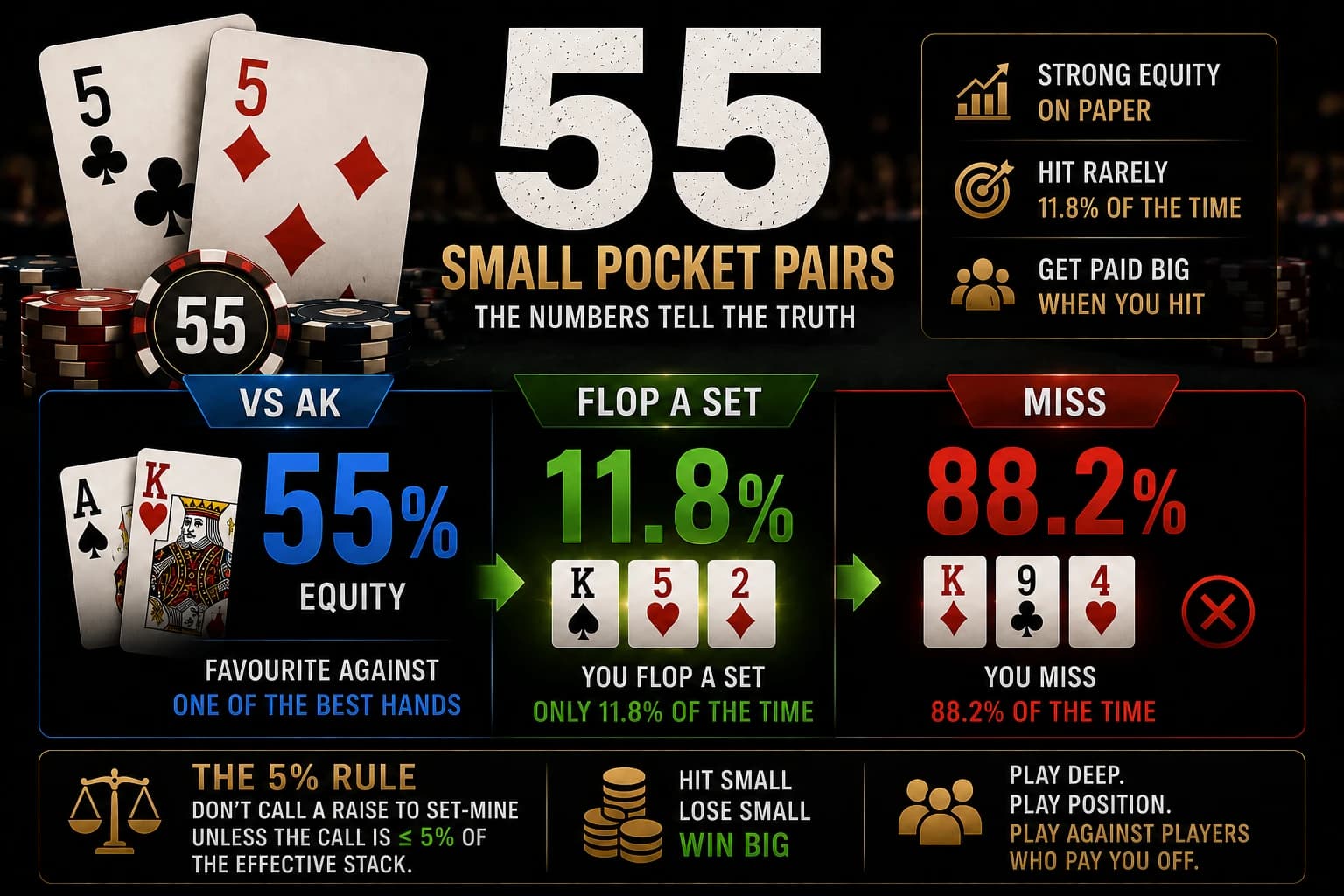
Small pocket pairs — deuces through sixes — are among the most misunderstood hands in poker. On their own they are rarely the best hand at showdown. Their value comes almost entirely from one thing: flopping a set (three of a kind), which is both powerful and beautifully disguised.
The maths of set-mining
When you hold a pocket pair, you will flop a set roughly 11.8% of the time — about one in eight and a half. That does not sound like much, but a set is a monster that usually wins a big pot, because opponents rarely see it coming. Chasing that outcome is what players call set-mining.
Implied odds are everything
Because you miss around seven times out of eight, set-mining only works when the reward for hitting is large enough to cover all the times you fold. That reward is your implied odds — the money you expect to win on later streets when you do connect. A common guideline is to call a preflop raise with a small pair only if you and your opponent are deep enough that hitting a set could win you many times the price of the call.
This is why small pairs shine in deep-stacked cash games and are far weaker in short-stacked situations: if there are not enough chips behind to win when you hit, the call does not pay for itself.
Position and discipline
Play small pairs more freely in position, where you control the pot and can realise your equity. Out of position, be more selective. And when you miss the flop — which is most of the time — be ready to let the hand go cheaply. The whole strategy depends on losing small and winning big; players who keep firing with an unimproved pair of fives give back everything the sets earn them.
Written by
GamblersPeak Editorial Team
Stay Updated
Get the latest casino news and exclusive bonus offers delivered to your inbox.