
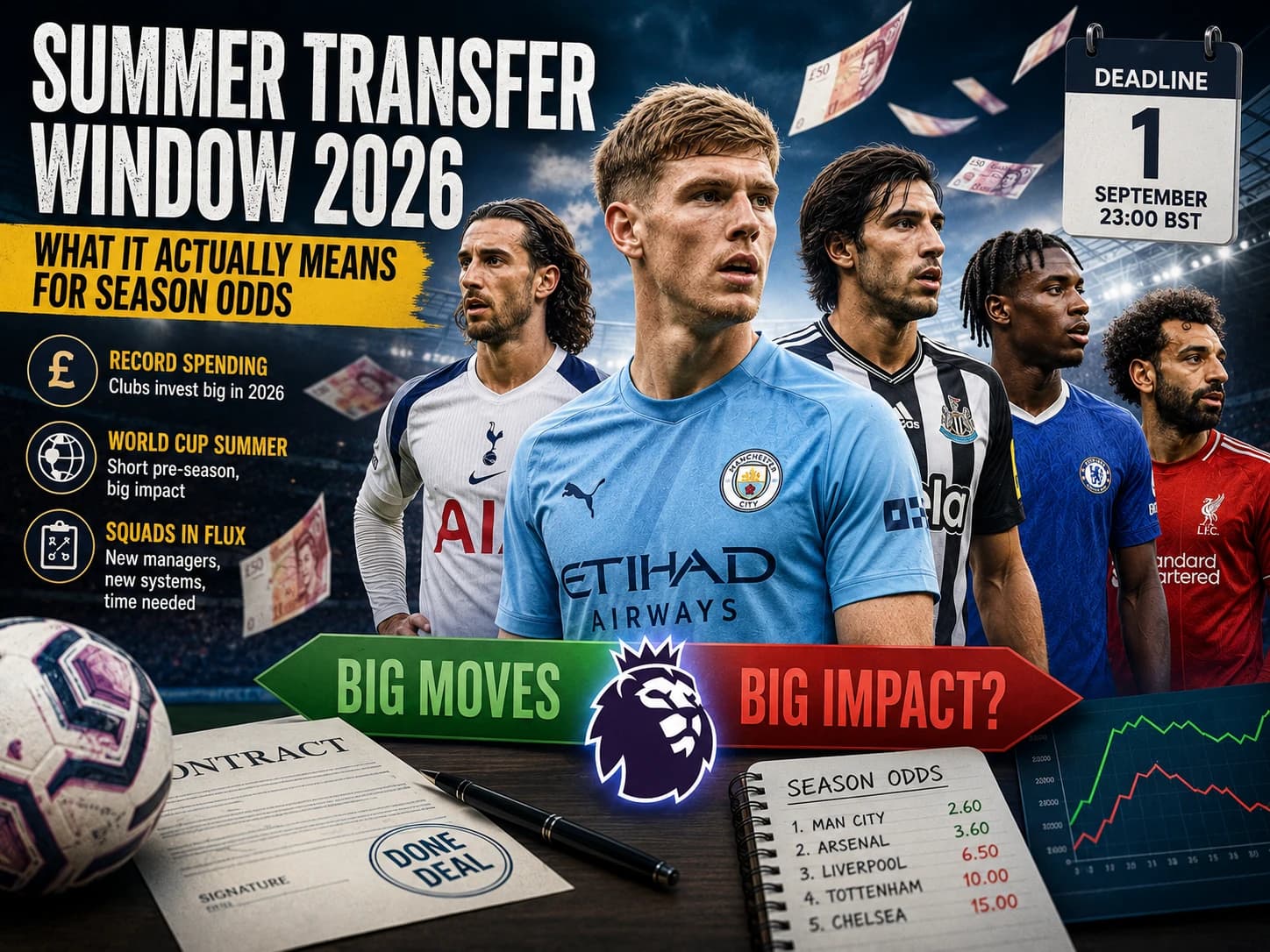
The Premier League transfer window opened on 15 June and closes on Tuesday 1 September at 23:00 BST. Between those dates, the outright markets for the 2026/27 season will move a great deal — and most of that movement will be wrong.
That is not cynicism. It is the most reliable pattern in football betting: the market reprices a club the moment a signing is announced, because that is when the news arrives, and it reprices it as though the player were already integrated, fit and productive. He is none of those things. He arrives in August, into a squad he does not know, in a season that starts on 21 August, after a summer in which many of the best players in Europe were playing a World Cup rather than resting.
This is a guide to reading the window properly. It is a live document and will be updated through to deadline day.
The window at a glance
| Club | Headline move | Fee |
|---|---|---|
| Manchester City | Elliot Anderson (in, from Nottingham Forest) | £116m |
| Tottenham | Sandro Tonali (in, from Newcastle) | up to £100m |
| Chelsea | Marc Cucurella (out, to Real Madrid) | £51.8m |
| Manchester United | Andrey Santos (in, from Chelsea) | £50m |
| Liverpool | Salah, Konaté & Robertson (out) | free |
| Arsenal | Piero Hincapié (made permanent) | — |
Where the money has gone
Manchester City have made the signing of the window: Elliot Anderson from Nottingham Forest for a reported £116m, a club record and the most expensive British player in history — surpassing the £115m Real Madrid paid for Jude Bellingham in 2023. He is 23, he is English, and he is currently playing in a World Cup semi-final. Reports indicate he completed a medical in Kansas and will formally complete the move after the tournament. This is the first signing of the post-Guardiola era, under new manager Enzo Maresca.
Tottenham have been the busiest club in the league by a distance, with spending reported at roughly £237m. Sandro Tonali arrived from Newcastle in a deal worth up to £100m, Mateus Fernandes from West Ham for a reported £85m, and Jan Paul van Hecke from Brighton for around £52m. They have added Andy Robertson, Marcos Senesi and Martin Dúbravka on free transfers. This is a squad being rebuilt from the middle outward under a new manager.
Liverpool have spent moderately — Jérémy Jacquet from Rennes, Víctor Muñoz from Osasuna — while losing Mohamed Salah, Ibrahima Konaté and Andy Robertson on free transfers. Read that sentence twice.
Chelsea continue to buy young and buy often: Marco Palestra from Atalanta, Geovany Quenda from Sporting, Emmanuel Emegha, Dastan Satpaev, Denner. Marc Cucurella was sold to Real Madrid for £51.8m. Andrey Santos has gone to Manchester United for £50m.
Arsenal, the champions, have done almost nothing — Piero Hincapié made permanent, Illan Meslier on a free. Strength, in transfer terms, looks like restraint.
Manchester United had not completed an incoming deal for most of the window and are only now moving. Newcastle reinvested the Tonali money across Bazoumana Touré, Sean Steur and Ewen Jaouen. Among the promoted clubs, Ipswich have been the most active; Coventry and Hull less so.
The three things the market gets wrong
1. It prices the signing, not the integration.
A £100m midfielder does not make a team £100m better in August. He makes them better in November, if the manager gets the shape right. Tottenham have signed a new central midfield, a new centre-back, three free-transfer veterans and appointed a new manager. That is not a squad that hits the ground running — that is a squad learning a system in public, in front of a title-race price that has already shortened on the strength of the outlay.
The historical pattern is consistent: clubs undergoing simultaneous managerial and squad turnover start slowly. If the market has moved Spurs up on spending alone, the early-season match markets are where that error becomes payable.
2. It underweights free-transfer departures.
Liverpool have lost Salah, Konaté and Robertson for nothing. Because no fee changed hands, the market's attention did not either. But a squad is not weakened in proportion to the money received for its departures — it is weakened in proportion to the minutes and quality that walked out of the door.
This is one of the few structural inefficiencies left in outright markets. Money spent is a headline. Quality lost on a free is a footnote. The scoreboard does not care which one made the back page.
3. It ignores what a World Cup summer does to August.
This is the single most important point in this article, and it is specific to 2026.
The tournament finishes on 19 July. The Premier League begins on 21 August. Players who reach the latter stages will have had a matter of weeks between a World Cup final and a league opener — no meaningful off-season, a compressed pre-season, and, for many, a transfer completed in the middle of it.
Elliot Anderson is the case study. He is in a World Cup semi-final today. He will join Manchester City having played a full international tournament, with a fraction of a normal pre-season, into a new club under a new manager, as the most expensive British signing in history and with the expectations that carries.
Multiple clubs across the league confirm the same pattern: business is being pushed late precisely because of the tournament, with players returning to club settings later than usual. The consequence is that squads will be less settled in August than in any recent season, and the sides least affected will be those whose key players went out early — or did not go at all.
That is a genuinely exploitable angle for the opening weeks. Not the title market, which will sort itself out over 38 games, but the early-season match odds, where a squad with six players returning from a deep World Cup run is being priced on last season's form.
What actually moves the odds — and what doesn't
| ✅ What actually moves the odds | ❌ What doesn't |
|---|---|
| Squad continuity | Social-media hype |
| Tactical fit of new signings | Shirt sales |
| Injury and fitness records | Pre-season friendly results |
| World Cup fatigue | The size of the transfer fee alone |
| A new manager bedding in | Who "won" the window on paper |
| Team chemistry and settled spine | Deadline-day drama |
How to use this
If you bet the outright market, bet it now or bet it late — not in the middle. Prices are softest before the herd has formed a view and again in mid-September once the first few results have punctured the summer narratives. In between, you are buying into hype at its peak.
If you bet the early match markets, the transfer window is a tool for identifying the unsettled, not the strengthened. Ask: how many first-team players did this club sign? Is there a new manager? How many players are returning from the last week of a World Cup? A club that answers "several," "yes," and "several" is a club whose August price is likely too short. Our bookmaker reviews cover which operators offer the best early-season prices and limits.
If you bet promoted clubs, be careful with the numbers. Ipswich have spent; Coventry and Hull, less so. Spending does not survive contact with the Premier League, but a lack of it rarely does either.
One caution on our own reasoning. The integration argument can be overstated. Manchester City signed Anderson to solve a specific problem, and elite players sometimes simply are better immediately. If City start well, the "he needs time" thesis looks like an excuse. We think the pattern holds across the league more often than it fails at any individual club — but it is a tendency, not a law, and we would rather flag that now.
Key dates
- Deadline: Tuesday 1 September, 23:00 BST. A short grace period typically applies for deals already lodged.
- Community Shield: 16 August, Cardiff.
- Season opens: 21 August.
Between the deadline and the opening weekend sits a two-week window in which squads are, briefly, knowable. That is the moment to reassess — not now, and not on deadline day itself, when the noise is loudest and the prices are at their worst.
Frequently asked questions
When does the 2026 summer transfer window close?
Tuesday 1 September 2026 at 23:00 BST. It opened on 15 June. A short grace period usually applies for deals already lodged before the deadline.
Which club has spent the most?
Tottenham, by a distance — reported at roughly £237m — ahead of Manchester City, whose £116m for Elliot Anderson is the single biggest deal of the window and a British transfer record.
How do transfers affect Premier League betting odds?
Usually too quickly. The market reprices a club the moment a signing is announced, as if the player were already integrated and fit. In reality new signings — especially after a World Cup summer — take weeks to settle, which is why early-season prices on heavily rebuilt squads are often too short.
Should I bet the title market now or later?
Now or late — not in the middle. Outright prices are softest before the herd forms a view, and again in mid-September once early results have punctured the summer narratives. In between, you are buying hype at its peak.
GamblersPeak Editorial. Transfer fees are as reported and frequently include add-ons; undisclosed fees make precise spending tables unreliable at this stage of the window. This article is updated as deals are confirmed. 18+. This article contains affiliate links; commercial relationships do not influence our editorial assessments. If gambling has stopped being entertainment, help is available — GamCare's National Gambling Helpline: 0808 8020 133, and the responsible-gambling tools every licensed operator must provide.
Written by
GamblersPeak Editorial Team
Our top-rated bookmakers
Our top-rated bookmakers, ranked by our reviews. Odds are the 1 (home) / X (draw) / 2 (away) price — indicative, they move constantly; check the operator before staking. 18+. Some links are affiliate links — commissions never affect our ratings.
Recreational bettors who want the best live betting and streaming in the business, huge market depth, competitive odds and a superb app, from a heavily regulated operator.
Bettors who want competitive odds, exceptionally deep prop and specials markets, and strong live betting and streaming from an award-winning, well-licensed and fast-rising operator.
Value bettors and winning players who want competitive odds and generous, tolerant betting limits from a long-established, well-licensed operator — plus anyone wanting a solid all-round book for sports, casino and poker in one account.
Bettors who want strong, often market-leading odds and huge market depth from a heavyweight, well-established and heavily licensed bookmaker with broad payment options.
Bettors who want a huge range of markets and bet types and the most flexible payment menu of the big brands — including e-wallets like Skrill, Neteller and Trustly — from a long-established, well-licensed operator.
New customers who want the most generous welcome bonus of the big brands, plus anyone after a safe, reliable, well-licensed all-round book with competitive odds and a well-rated app.
Stay Updated
Get the latest casino news and exclusive bonus offers delivered to your inbox.