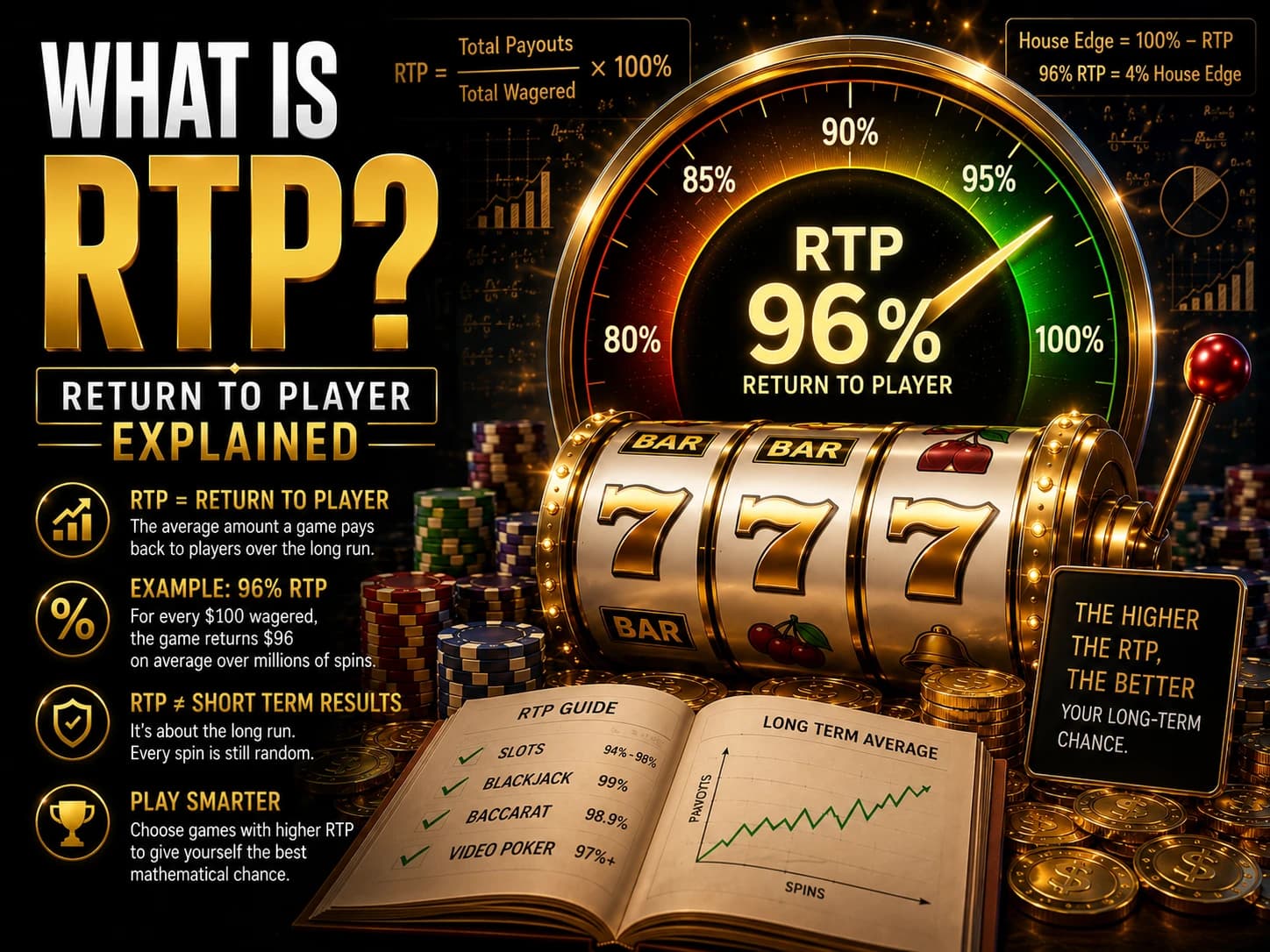
RTP stands for Return to Player. It is a percentage that tells you how much a casino game pays back to players over the long run. If a slot has an RTP of 96%, it means that — across millions of spins — the game returns an average of $96 for every $100 wagered. The remaining $4 is the casino's built-in margin, known as the house edge.
Understanding RTP is one of the simplest ways to play smarter. It won't guarantee a win on any single session, but over time it tells you which games give you the best mathematical chance of holding on to your money. This guide explains exactly how RTP works, how it is calculated, what counts as a good RTP, which games and slots pay back the most, how RTP differs from volatility, and the common myths you should ignore.
What is RTP?
RTP (Return to Player) is the percentage of all wagered money that a casino game is mathematically expected to pay back to players over a very large number of spins or rounds. A 96% RTP means roughly $96 is returned for every $100 staked over the long run, while the casino keeps about 4% as the house edge.
How does RTP work?
RTP is a long-term statistical average, not a promise for your next session. Casino games use a Random Number Generator (RNG) to make every spin or hand completely independent and random. The RTP figure is calculated over an enormous number of rounds — often millions or even billions.
Here's a simple example. Imagine a slot with a 96% RTP:
- Over a very long period, the game is designed to return about 96% of all money wagered to players as winnings.
- The casino keeps roughly 4% on average — that's the house edge.
- In a single session you could win far more than you stake, or lose it all. RTP only describes the long-term trend.
How is RTP calculated?
RTP is calculated by dividing the total amount returned to players by the total amount wagered, measured across a huge sample of rounds, then expressed as a percentage:
RTP = (Total returned to players ÷ Total amount wagered) × 100
For example, if a game pays out $9,600,000 from $10,000,000 in total bets, its RTP is (9,600,000 ÷ 10,000,000) × 100 = 96%. Because the sample is so large, short sessions tell you nothing reliable — the percentage only stabilises over millions of rounds. Game studios certify this figure with independent testing labs before release, which is why you can trust the published RTP at a licensed casino.
Why RTP matters
RTP matters because it directly affects how long your bankroll lasts and how much value you get from your play. A game with a 97% RTP gives back significantly more over time than one at 92% — and that difference compounds across hundreds or thousands of bets.
Think of it this way: if you wager $1,000 across a 96% RTP slot, the math expects roughly $960 back over the long run. On an 88% RTP game, you'd expect only about $880 back. Choosing higher-RTP games won't make you a guaranteed winner, but it tilts the odds as far in your favour as possible — and that's the smartest habit any player can build. It's also why serious players check RTP before they ever deposit at a new online casino or claim a casino bonus.
RTP vs. house edge
RTP and house edge are two sides of the same coin and always add up to 100%:
- RTP = the share returned to players (e.g. 96%).
- House edge = the share the casino keeps (e.g. 4%).
So a game with a 97% RTP has a 3% house edge, while a game with a 94% RTP has a 6% house edge. A higher RTP is better for you, because it means a lower house edge.
RTP vs. volatility
RTP only tells you half the story. The other half is volatility (also called variance), which describes how a game pays out — not how much overall. This is the section most beginners miss, and the two are very often searched for together.
- High-volatility games pay rarely but in large bursts. You can endure long losing streaks, then hit a big win. Two slots can share a 96% RTP yet feel completely different because of this.
- Low-volatility games pay smaller amounts frequently, keeping your balance steadier and your session longer.
So always read RTP and volatility together. A high RTP with low volatility suits players who want long, steady sessions; a high RTP with high volatility suits those chasing rare big wins and willing to ride out dry spells. Neither is "better" — it depends on your bankroll and your goals. You can browse titles by style in our online slots guide.
What is a good RTP?
As a rule of thumb, an RTP of 96% or higher is considered good for online slots. Table games typically offer even higher returns when played correctly. Use this quick scale to judge any slot at a glance:
| RTP | What it means |
|---|---|
| Below 94% | Low — avoid where possible |
| 94% – 95% | Below average |
| 96% | Good (the online-slot benchmark) |
| 97% and above | Excellent |
And here is how the main casino games typically compare:
| Game | Typical RTP | House edge |
|---|---|---|
| Blackjack (basic strategy) | 99.50% | 0.50% |
| Video Poker (full-pay) | 99.00%+ | under 1% |
| Baccarat (Banker bet) | 98.94% | 1.06% |
| European Roulette | 97.30% | 2.70% |
| Online slots (average) | 94.00% – 97.00% | 3.00% – 6.00% |
| American Roulette | 94.74% | 5.26% |
Highest RTP casino games
If your priority is the best possible odds, skip the flashy slots and head to the table games. The following consistently offer the highest RTP in any casino:
- Blackjack — with correct basic strategy, the house edge drops to around 0.5% (99.5% RTP), the best in the house. Learn more in our live dealer casinos guide.
- Baccarat — the Banker bet returns about 98.94%, with very simple rules.
- Video Poker — full-pay variants like Jacks or Better can reach 99%+ when played optimally.
- Craps — the basic Pass/Don't Pass line bets carry a low house edge of around 1.4%.
Best high-RTP slots
Most players still love slots, and the good news is that some titles are far more generous than the 96% average. These are among the highest-RTP slots available at reputable casinos:
| Slot | Provider | Advertised RTP |
|---|---|---|
| Mega Joker | NetEnt | up to 99% |
| Book of 99 | Relax Gaming | 99% |
| 1429 Uncharted Seas | Thunderkick | 98.6% |
| Blood Suckers | NetEnt | 98% |
| Starmania | NextGen | 97.87% |
| Book of Dead | Play'n GO | 96.21% |
You can browse more titles in our online slots section or by studio on our game providers hub. Remember that the figures above are the advertised RTP — and as the next section explains, the version a casino actually runs can differ.
Can casinos change a game's RTP?
This is one of the most important — and least understood — facts in modern online gambling. The answer is: not directly, but they can choose which version to offer.
Many studios such as Pragmatic Play, Play'n GO and others now release the same slot in multiple RTP versions. A single game like Book of Dead might ship in a 96%, 94% or even 91% configuration, and the operator decides which one to put on its site. That means the exact same slot can pay back noticeably more at one casino than at another.
Your takeaway as a player: always check the game's info screen (the "i" or paytable) before you play, because that's where the live RTP of that specific version is shown. If a casino runs stingy low-RTP versions of popular games, that's a red flag — and a good reason to stick with the trusted operators in our casino reviews.
RTP in crypto & provably fair games
If you play at crypto casinos, you'll meet a newer category: provably fair games such as crash games (like Aviator), dice and plinko. These often advertise a fixed, very high RTP of around 97% to 99%.
Their big advantage is transparency. Using cryptographic hashing, you can verify the fairness of each round yourself — the outcome is provably not manipulated after you bet. Combined with the fast, low-fee transactions of cryptocurrencies, this is a major reason provably fair games have exploded in popularity. Just remember that a 99% RTP crash game can still be extremely high-volatility, so the same bankroll rules apply.
Common RTP myths
A lot of confusion surrounds RTP. Let's clear up the biggest myths:
- "A high RTP guarantees winnings." False. RTP is a long-term average over millions of rounds. In any real session you can lose on a 99% game or win on a 90% one.
- "RTP applies to my session." False. It says nothing about your next 50 spins — only the long-run trend across all players.
- "Slots run hot and cold." False. Thanks to the RNG, every spin is independent. A game is never "due" for a win, and a recent payout doesn't make the next one more or less likely.
How to find a game's RTP
Reputable, licensed casinos and studios publish RTP openly. You'll usually find it in the game's info or paytable screen (look for an "i" icon), on the provider's official website, or on independent review databases. When in doubt, stick to licensed operators whose games are independently tested by labs such as eCOGRA or iTech Labs.
Conclusion
RTP is the single most useful number for understanding the long-term value of a casino game. A higher RTP means a lower house edge and a better mathematical chance of stretching your bankroll. Use it as a guide — combine a strong RTP with a volatility level that suits your style, always check the specific version a casino runs, and play only at licensed casinos. Above all, gamble responsibly and only with money you can afford to lose. For more essentials, explore our full casino guides.
Frequently asked questions about RTP
What is a good RTP percentage?
For online slots, an RTP of 96% or higher is considered good and 97%+ is excellent. Many table games go higher still — blackjack with basic strategy reaches around 99.5%.
Is 96% RTP good?
Yes. 96% is the widely used benchmark for a good online slot. It means about $96 is returned per $100 wagered over the long run, leaving a 4% house edge.
Is 95% RTP good?
95% is slightly below average for modern online slots. It's playable, but with so many 96%–97% games available you can usually find a better-value title with a quick check of the info screen.
Can RTP guarantee winnings?
No. RTP is a long-term statistical average across millions of rounds. It does not predict or guarantee the result of any single session — you can lose on a 99% game or win on a 90% one.
Which casino games have the highest RTP?
Blackjack played with basic strategy has the highest RTP (about 99.5%), followed by full-pay video poker (99%+), baccarat (98.94% on the Banker bet) and European roulette (97.3%). Among slots, titles like Mega Joker and Book of 99 reach up to 99%.
Is RTP the same as odds?
Not exactly. Odds describe the chance of a specific outcome on a single bet, while RTP describes the average percentage of all wagers returned to players over time. RTP effectively bundles the odds and payouts of a game into one long-run figure.
Does RTP change?
A casino can't alter a game while you play, but many slots ship in several RTP versions and the operator chooses which to offer. Always check the game's info screen for the live RTP at that specific casino.
Does RTP matter in the short term?
Barely. Over a handful of spins, variance (volatility) dominates and almost anything can happen. RTP only becomes meaningful over thousands or millions of rounds, which is why it's a guide for game selection, not a session predictor.
How is RTP calculated?
RTP is the total amount returned to players divided by the total amount wagered, measured over a very large number of rounds and expressed as a percentage: RTP = (returned ÷ wagered) × 100.