Ace-King — "Big Slick" — is the strongest unpaired hand in Texas Hold'em and one of the most misplayed. Beginners lose money with it for a single reason: they treat it like a made hand. It isn't. AK is a drawing hand. Pocket aces and kings are already made pairs; AK is two high cards that still need to improve. Understand that one distinction and you already play it better than most of the table.
This guide covers the equity reality with real numbers, how suited and offsuit differ, how to play AK before and after the flop, how cash games and tournaments change the picture, and the specific leaks that cost beginners their stacks. New to the game? Start with how to play Texas Hold'em, or see the full starting hands guide for the hand-selection framework.
Why AK Is So Strong — and Why It's a Trap
Two things make AK special. First, nut potential: pair either card and you often hold top pair with the best possible kicker (TPTK), and AK makes the highest flush and Broadway straights. Second, domination: AK crushes the other big hands people love to play — AQ, AJ, KQ — because you share a card and hold the higher one. Against A-Q, AK wins roughly 70% of the time.
The trap is the flip side. AK is unpaired, so on any given flop you will pair one of your cards only about a third of the time. The other two-thirds you hold "just" ace-high. Players who marry AK — who commit chips as if they've already got a monster — bleed away everything they win with it on the times it misses.
The Equity Reality (With Numbers)
Here is how AK actually performs all-in before the flop, heads-up. These figures are why AK is played aggressively but not blindly:
| AK is up against… | AKs (suited) | AKo (offsuit) |
|---|---|---|
| A random hand | ~67% | ~65% |
| A pair below kings (e.g. 99, JJ) | coinflip, ~46–50% | coinflip, ~45–48% |
| Queens (QQ) | ~46% | ~43% |
| Kings (KK) | ~34% | ~30% |
| Aces (AA) | ~12% | ~7% |
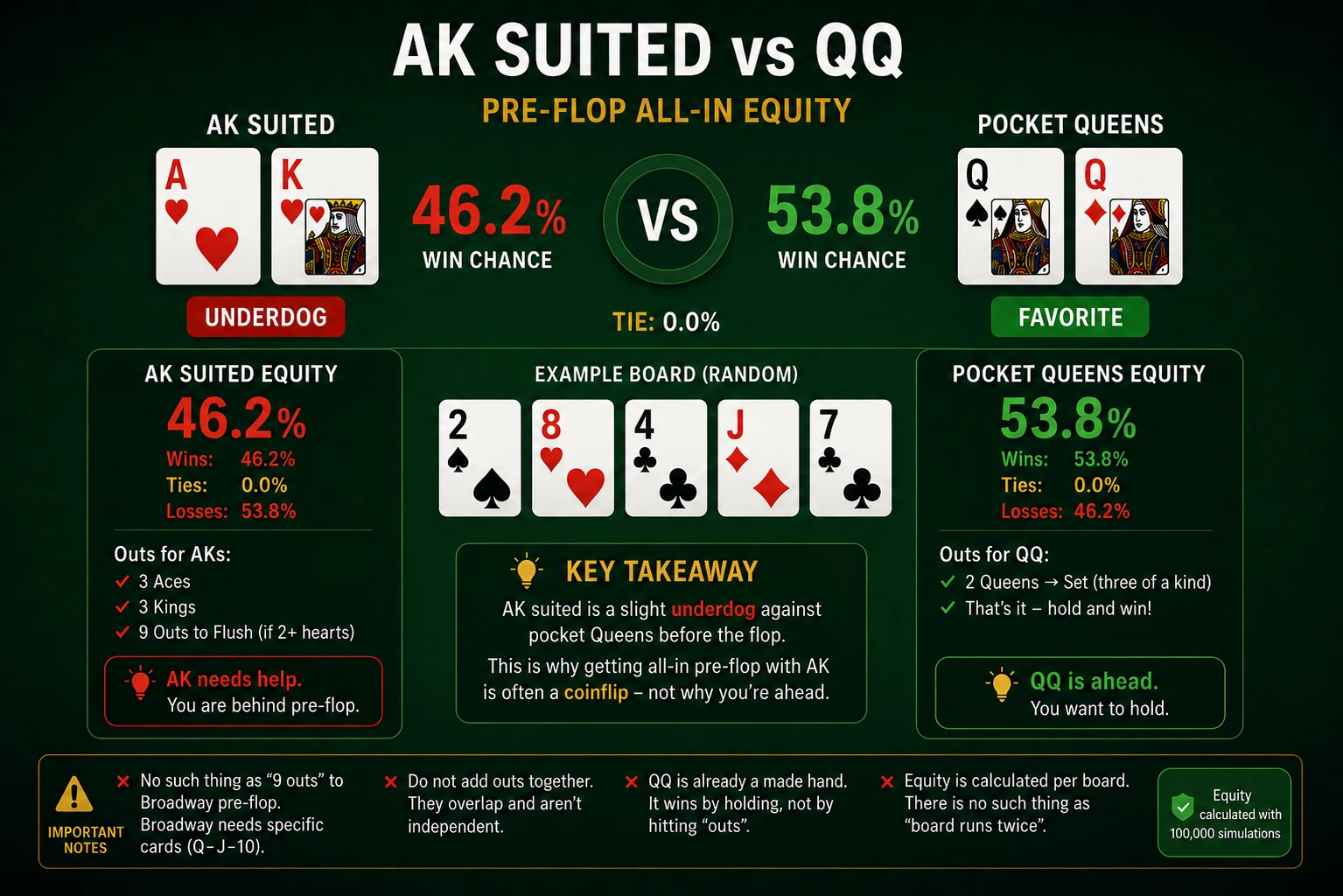
Read what this says. AK is a favourite against non-paired hands and a coinflip against most pairs — which is exactly the "race" you hear players talk about. But against the two hands that dominate it, KK and AA, you are a heavy underdog, and offsuit AK especially so. This is why getting all-in pre-flop with AK is usually correct (you have fold equity plus a coinflip-or-better against most calling ranges) but not always — against the tightest players who only ever get it in with QQ+, you can be crushed.
Suited vs Offsuit: How Much It Matters
AKs (suited) is a genuine premium hand — a top-five holding — because the flush adds equity and, crucially, playability: you flop flush draws, back-door flush equity, and more ways to keep barreling when you miss the pair. AKo (offsuit) is still a premium hand and almost never folded for a single raise or 3-bet, but it has slightly less equity and fewer post-flop escape routes. The practical difference: AKs is happy getting it in a little wider and bluffing a little more; AKo occasionally folds to the very heaviest pre-flop aggression from very tight opponents where AKs would call. For a beginner, the takeaway is simply: both are raising hands, suited is stronger, and offsuit is the one you fold in the rare, extreme spots.
Playing AK Before the Flop
The governing rule: AK is a hand to bet and raise with, not to call with. Its value comes from two sources — the times it improves, and the times it makes better hands fold. Passively calling wastes both.
- Nobody has raised yet: raise. Don't limp. Limping AK surrenders the initiative and invites a crowd of hands that can outdraw you.
- Someone has raised: re-raise (3-bet) in most spots. This isolates the raiser, builds a pot you have an equity edge in, and gives you fold equity.
- Facing a 3-bet or 4-bet: AK is a premier 4-betting hand. Deep-stacked at 100 big blinds, getting stacks in pre-flop with AK is standard against normal ranges. The main exception is a 5-bet all-in from a demonstrably tight player — against a range of only QQ+/AK you are behind, and offsuit AK in particular becomes a fold.
The recurring beginner error is the opposite of all this: flatting or slow-playing AK, hoping to "see a flop cheaply." AK doesn't want a cheap multiway flop; it wants to be heads-up in a pot it built.
Playing AK After the Flop
Since you will miss the pair two times out of three, post-flop play divides cleanly.
When you hit (top pair, top kicker): you usually have the best hand — bet it for value. But respect the TPTK trap: top pair is still one pair. On wet, connected, or two-suited boards, and against passive players who suddenly wake up with a raise, one pair loses to two pair, sets and completed draws. Value-bet confidently; stack off cautiously, especially on scary runouts.
When you miss (ace-high): you have two overcards and, if suited, often back-door equity — enough to keep applying pressure but not to commit your stack. As the pre-flop raiser you'll continuation-bet most flops, and AK is one of the best hands to do it with, because even a miss can turn into the best hand and you retain outs when called. The discipline is knowing when to give up: if you fire, get called, and the board offers you nothing, ace-high is a fine hand to check and fold rather than bluff off your chips. Ace-high also makes a strong bluff-catcher against opponents who over-bluff.
Position, as always, decides how easy this is. In position you control the pot size and get a free look at your opponent's action; out of position AK is far harder to play well. Prefer to enter pots with AK where you'll have position after the flop.
Cash Games vs Tournaments
AK's core play is the same, but the emphasis shifts:
- Cash (deep stacks): more post-flop finesse. You can 3-bet, c-bet, and then make disciplined lay-downs when TPTK looks beaten. The all-in-pre-flop spots are rarer.
- Tournaments (shorter stacks): AK becomes a premier shoving and re-shoving hand. Short-stacked, its combination of raw equity and fold equity makes moving all-in — or calling an all-in — routinely correct. The famous "AK coinflip for tournament life" is a defining moment precisely because AK is the hand you're willing to race with. The shallower your stack, the more AK simply wants to get all the chips in before the flop.
The Common Leaks
- Marrying AK. Treating it as a made hand and refusing to fold when the board and action say you're beaten.
- Limping or flatting pre-flop instead of raising or 3-betting — surrendering initiative.
- Over-committing on a miss. Stacking off with ace-high because "it's AK."
- Never folding offsuit AK even against ranges that only get it in with QQ+/AA/KK.
- Playing it out of position without a plan and then guessing on every street.
The Lineage: Why "Play It Fast" Still Holds
The classic advice — AK is a drawing hand, so play it fast and aggressively — traces back to the road-gambler aggression of Doyle Brunson's era and David Sklansky's foundational thinking about equity and initiative. It has aged unusually well. Modern solver analysis confirms the same conclusion from the other direction: AK sits at the top of 3-betting and 4-betting ranges precisely because its equity-plus-fold-equity profile rewards aggression over passivity. Where the modern game refines the old wisdom is in the details — exact sizings, which boards to barrel, when offsuit AK should fold to a 5-bet — not in the core instinct. Concept from the classics, precision from the solvers.
Quick Reference
- AK is a drawing hand, not a made hand. It usually needs to improve.
- Raise and re-raise; don't limp or flat. Value comes from betting, not calling.
- Getting it in pre-flop is usually right — coinflip-or-better against most ranges — except against the tightest all-in ranges (QQ+), where offsuit AK folds.
- You'll pair the flop ~⅓ of the time. Have a plan for the other ⅔.
- TPTK is still one pair. Value-bet it; don't marry it.
- Position and suitedness both make AK easier to play.
Frequently Asked Questions – Ace-King
Is Ace-King a good hand?
Yes — AK is the strongest unpaired starting hand and one of the best hands in Hold'em. It's a favourite against every non-paired hand and roughly a coinflip against most pairs. The key is remembering it's a drawing hand that usually needs to improve, not a made hand like pocket aces.
Should I go all-in with AK before the flop?
Usually, yes — against normal ranges AK has a coinflip-or-better share plus fold equity, so getting stacks in pre-flop is standard, especially in tournaments. The exception is a 5-bet all-in from a very tight player whose range is only QQ+; there, offsuit AK in particular is a fold.
Is AK better than QQ or JJ?
Before the flop, AK is roughly a coinflip against queens or jacks — slightly behind, not crushed. AK has more upside (nut potential, domination of weaker aces) but has to improve, while a pair is already made. Neither dominates the other; that's exactly why these confrontations are called races.
How much difference does suited vs offsuit make?
A few percent of equity and, more importantly, playability. Suited AK flops flush draws and has more ways to keep betting when it misses the pair, making it a genuine top-five hand. Offsuit AK is still premium but slightly weaker and the one you fold in the most extreme pre-flop spots.
What do I do when AK misses the flop?
You'll miss the pair about two-thirds of the time and hold ace-high, often with two overcards and back-door equity. As the pre-flop raiser, continuation-bet most flops — but be willing to check and fold if you fire, get called, and the board gives you nothing. Ace-high is not a hand to stack off with.
Is AK a made hand?
No, and this is the single most important thing to understand about it. AK is unpaired — a drawing hand that needs to pair or make a straight or flush. Pocket aces and kings are made hands; AK is the strongest hand that still has to improve.
Where to Go Next
- Back to the starting hands guide for the full framework and chart.
- New to the game? Start with how to play Texas Hold'em.
- Ready to play? Our poker hub helps you find a room that accepts players from your country.