When the Premier League season begins on 21 August, something will be missing. For the first time in over a decade, no club will run out with a betting company's logo on the front of its shirt. Several clubs may run out with nothing there at all.
This is the most significant change to gambling advertising in British football in a generation, and it is almost universally misunderstood — including, we suspect, by many of the people celebrating it. What follows is what the rule actually does, what it conspicuously does not do, and why the money involved explains the outcome better than morality alone.
Timeline
| When | What happened |
|---|---|
| April 2023 | Premier League clubs vote, voluntarily, to remove gambling brands from the front of matchday shirts |
| 2023 | The government publishes its long-awaited gambling White Paper |
| End of 2025/26 | The last season in which betting logos are permitted on shirt fronts |
| 2026/27 | The ban takes effect — this season |
What was agreed
In April 2023, the twenty Premier League clubs collectively agreed to remove gambling sponsorship from the front of matchday shirts, making the Premier League the first UK sports league to adopt such a measure voluntarily. The agreement followed consultation with the clubs and the Department for Culture, Media and Sport as part of the government's review of gambling legislation.
The word doing the heavy lifting there is voluntarily. This was not a ban imposed by Parliament or by the Gambling Commission. It was a pre-emptive move by the clubs, made while a White Paper on gambling reform was in preparation, and its evident purpose was to avert legislation by demonstrating that the industry could regulate itself. Whether that worked is a question for a different article.
Clubs were given a long runway. Existing deals were permitted to run to the end of the 2025/26 season, and clubs remained free to sign new front-of-shirt gambling deals right up until the ban commenced. The rule takes effect for 2026/27 — this season.
What is banned, and what is not
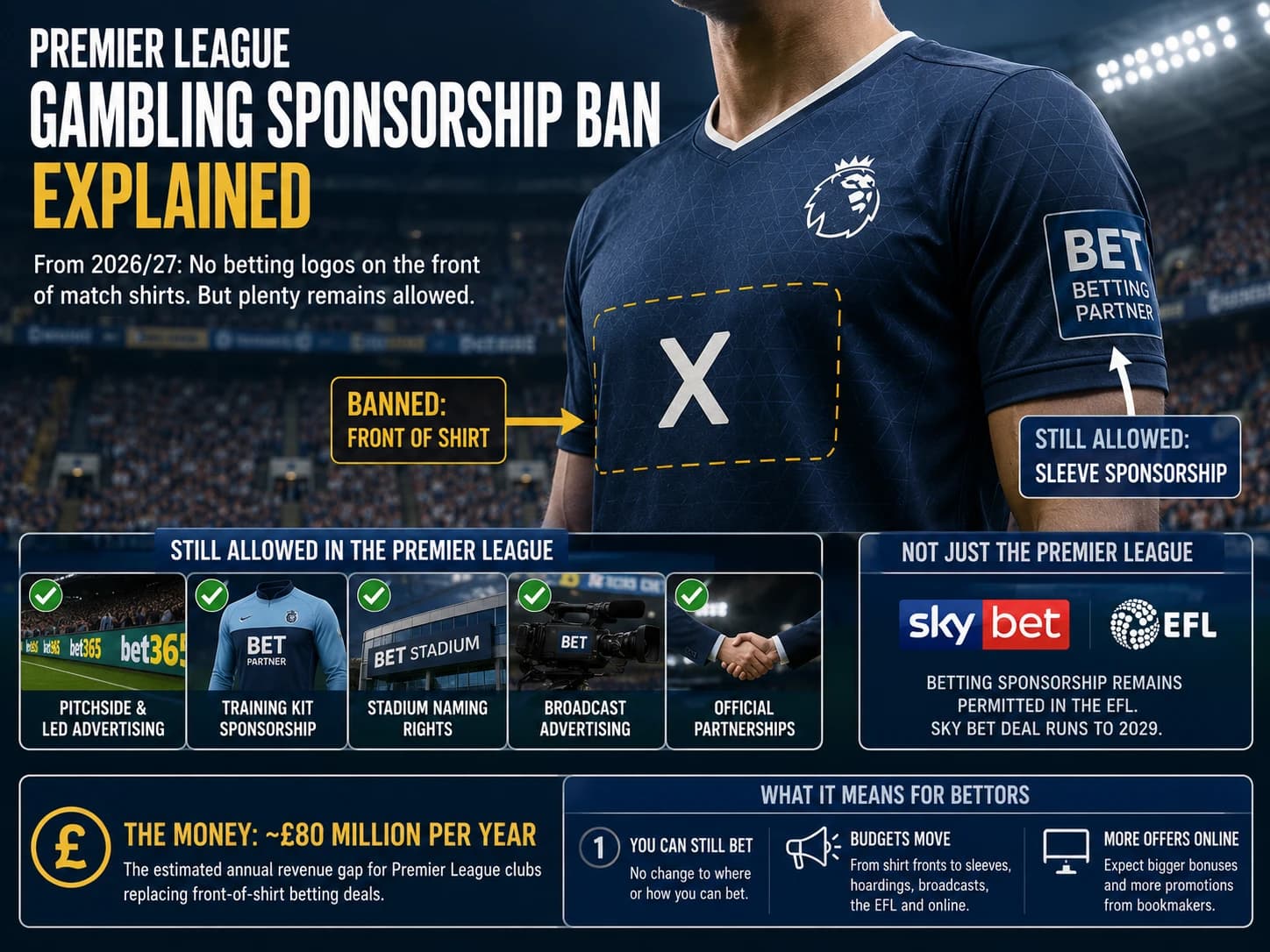
Banned: a betting company's logo on the front of a matchday shirt. Still permitted: almost everything else.
| Still allowed | Banned |
|---|---|
| Sleeve sponsorship | Betting logo on the front of the matchday shirt |
| Training-kit sponsorship | |
| Stadium naming, pitchside & LED advertising | |
| Official partnership designations | |
| Broadcast advertising | |
| Front-of-shirt gambling deals in the EFL (Sky Bet, to 2029) |
Set out plainly, the shape of the thing becomes obvious. This is not a removal of gambling advertising from football. It is the removal of gambling advertising from a single piece of fabric — the most visible and most expensive piece, admittedly, but one piece. A supporter watching a Premier League match this season will still see betting brands on sleeves, on the hoardings that ring the pitch, on the training kit in the pre-match warm-up, and in the commercial breaks.
Clubs such as West Ham, whose front-of-shirt partner was Betway, are among those reported to have shifted their betting sponsors to the sleeve. That is not a loophole. It is the rule working as written.
The money
A large share of the league carried betting brands on the front of their shirts last season, and every one of those clubs has needed a replacement. The estimated collective revenue hit across the league is around £80 million per year. That figure requires some unpacking, because it is not a straight loss — it is the gap between what gambling companies paid and what anyone else will.
And that gap is large, because gambling operators were not paying market rate for Premier League shirt fronts. They were paying far above it. The clearest example is Bournemouth. According to The Sponsor, a sponsorship-industry publication, the club's front-of-shirt deal with the betting brand BJ88 — worth around £8 million a year — was priced at 185% above the club's fair market value of roughly £2.8 million. Their replacement, Vitality (already the club's stadium sponsor), is understood to be worth around £4–5 million. Brentford have taken a similar route, elevating training-kit partner Indeed to the front of the shirt.
That premium — a gambling brand paying nearly three times fair value for a shirt front — is the crux of the entire issue. For an operator targeting Asian markets, where the Premier League is watched by hundreds of millions and where the brand's licensing position is often ambiguous, a shirt front is not advertising. It is the whole marketing strategy.
Take that away and the asset reprices to what a bank or a jobs site will pay. Which is less.
Who is exposed
As of the most recent public reporting, a number of clubs had not confirmed a replacement; the Guardian reported in April that around nine clubs had yet to secure front-of-shirt deals. Chelsea, unusually, have begun several recent seasons without a shirt sponsor and signed short-term deals afterwards — for them this is business as usual.
Among the promoted clubs, Coventry City arrive settled, having renewed the digital bank Monzo for a third consecutive season and earning the brand its first Premier League exposure — fittingly, as Coventry open the campaign away at champions Arsenal. Other newly promoted sides have had far less time to find a sponsor. The realistic prospect, for the first time in living memory, is Premier League clubs playing competitive matches with blank shirt fronts.
What it means if you bet
Three things, in ascending order of importance.
First, nothing changes about where or how you can bet. No operator has lost a licence. No market has closed. The rule governs where a logo may appear, not what a bookmaker may offer. If you want to compare operators, our bookmaker reviews are unaffected by any of this.
Second, the money does not evaporate — it moves. An operator with an £8m Premier League shirt budget has not stopped wanting British customers. That budget is being redeployed into the channels that remain open: sleeves, hoardings, broadcast, EFL shirts, and direct-to-consumer marketing. Early indications suggest displaced operators may redirect spending toward the EFL, where shirt sponsorship remains permitted.
Third — and we will be direct about this, because the alternative is to pretend otherwise — a meaningful share of that displaced budget flows into affiliate marketing. Sites like this one. When a bookmaker cannot buy a shirt front, it buys visibility somewhere else, and one of the somewhere-elses is the review site telling you which bookmaker to choose. That is a structural conflict of interest, it applies to us as much as to anyone, and the correct response is not to hide it but to state it and then be judged on whether our assessments are honest anyway.
The practical consequence for you: expect more aggressive acquisition offers this season. Bigger sign-up bonuses, more free-bet promotions, heavier affiliate marketing. That is not generosity. It is £80m of marketing budget looking for a new home — so treat the incoming offers as marketing, read the terms, and if betting stops being fun, use the responsible-gambling tools that every licensed operator must provide.
The wider argument
The Premier League's decision is defended as a genuine harm-reduction measure and criticised as a cosmetic one. Both readings have support.
The case for it: the shirt front is the single most visible commercial surface in football, worn by children, and removing betting logos from it reduces the normalisation of gambling among young fans. Carolyn Harris, chair of the Gambling-Related Harms All-Party Parliamentary Group, has argued precisely this — that shirt sponsorship normalises gambling for children.
The case against: campaigners including The Big Step, a group led by people harmed by gambling and by bereaved families, argue that a ban confined to shirt fronts while permitting sleeves, hoardings and broadcast advertising is not harm reduction but rearrangement. A child watching a match will see the same brands in slightly different places.
Our own position, for what it is worth: the shirt-front ban is a real change with real financial consequences, and it is also demonstrably not what most people think it is. Both of those can be true. The £80m figure proves the change is not cosmetic — nobody gives up £80m for a gesture. The persistence of gambling branding everywhere else in the stadium proves it is not a solution either.
Frequently asked questions
When does the Premier League gambling sponsorship ban start?
It takes effect for the 2026/27 season, which kicks off on 21 August 2026. Clubs agreed the measure voluntarily back in April 2023 and were given until the end of 2025/26 to run down existing deals.
Are betting companies banned from the Premier League?
No. Only the betting logo on the front of the matchday shirt is banned. Betting brands can still appear on sleeves, training kit, pitchside and LED hoardings, stadium naming rights, official partnerships and broadcast advertising.
Can bookmakers still advertise in football?
Yes — extensively. The ban covers a single surface: the Premier League shirt front. Everywhere else, including the EFL, whose competitions are sponsored by Sky Bet through 2029, gambling sponsorship remains legal.
Can Premier League clubs still have betting sponsors?
Yes, just not on the front of the shirt. Several clubs have moved their betting partners to sleeve sponsorship, which remains permitted.
Which clubs were affected?
A large share of the league carried betting brands on their shirt fronts last season. Examples include Bournemouth (BJ88, replaced by Vitality), Brentford (now Indeed) and West Ham (Betway).
GamblersPeak Editorial. This article contains affiliate links, and GamblersPeak earns commission from operators listed on this site. As noted above, that is a structural conflict of interest, and we disclose it rather than obscure it. Commercial relationships do not influence our editorial assessments. 18+. If gambling has stopped being entertainment, help is available — GamCare's National Gambling Helpline: 0808 8020 133.
Written by
GamblersPeak Editorial Team
Our top-rated bookmakers
Our top-rated bookmakers, ranked by our reviews. Odds are the 1 (home) / X (draw) / 2 (away) price — indicative, they move constantly; check the operator before staking. 18+. Some links are affiliate links — commissions never affect our ratings.
Recreational bettors who want the best live betting and streaming in the business, huge market depth, competitive odds and a superb app, from a heavily regulated operator.
Bettors who want competitive odds, exceptionally deep prop and specials markets, and strong live betting and streaming from an award-winning, well-licensed and fast-rising operator.
Value bettors and winning players who want competitive odds and generous, tolerant betting limits from a long-established, well-licensed operator — plus anyone wanting a solid all-round book for sports, casino and poker in one account.
Bettors who want strong, often market-leading odds and huge market depth from a heavyweight, well-established and heavily licensed bookmaker with broad payment options.
Bettors who want a huge range of markets and bet types and the most flexible payment menu of the big brands — including e-wallets like Skrill, Neteller and Trustly — from a long-established, well-licensed operator.
New customers who want the most generous welcome bonus of the big brands, plus anyone after a safe, reliable, well-licensed all-round book with competitive odds and a well-rated app.
Stay Updated
Get the latest casino news and exclusive bonus offers delivered to your inbox.