
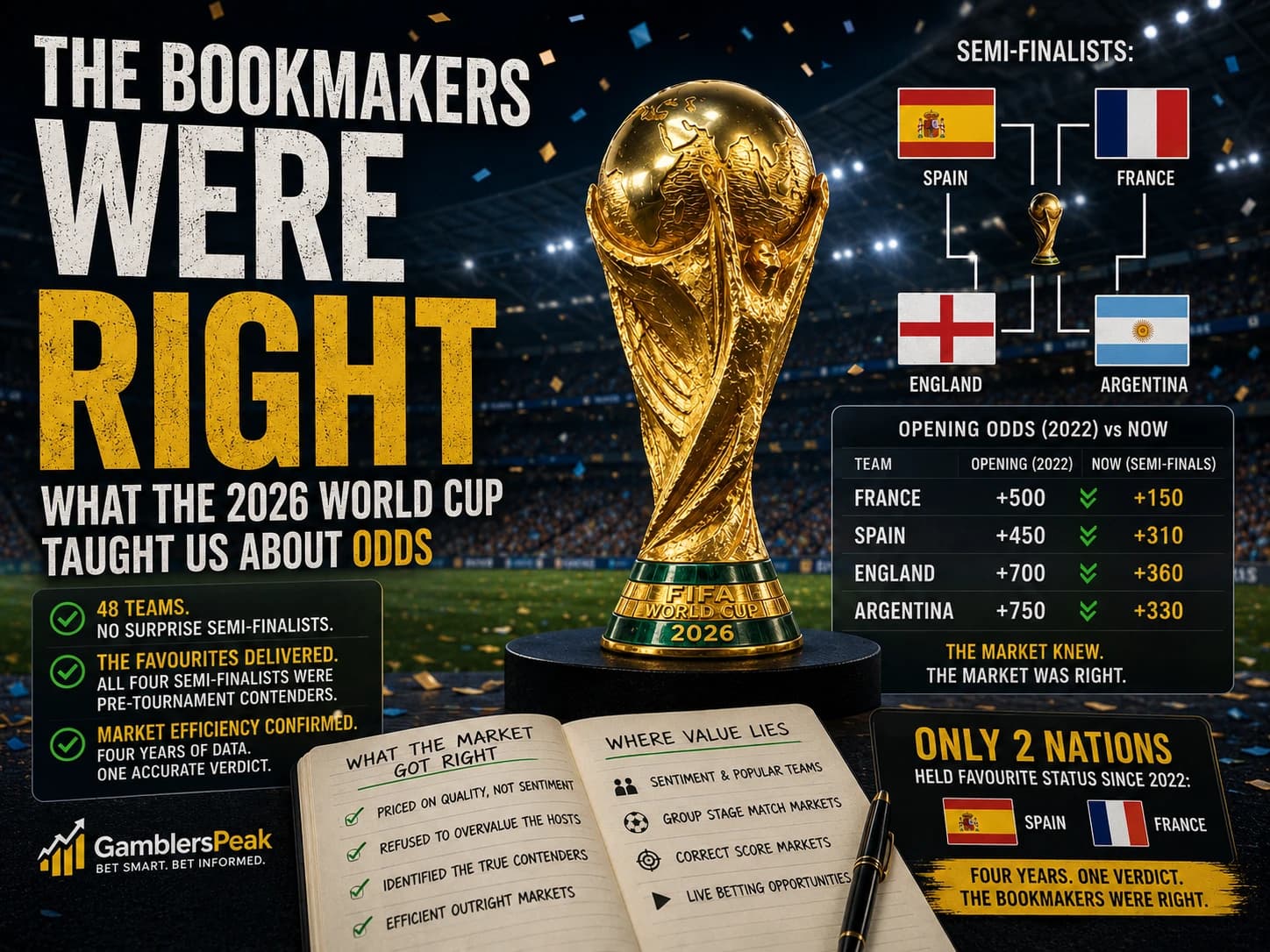
We set out to write a different article. The working title was "How the Bookmakers Got the 2026 World Cup Wrong" — the biggest tournament ever staged, 48 teams, three host nations, a format nobody had tested, and surely somewhere in all that chaos the pricing models would have broken.
They did not. And that turns out to be the more interesting story.
The scoreboard
When the tournament began, Spain and France were the co-favourites at BetMGM, both priced at +450 (9/2). They are playing each other in the semi-final in Dallas. England and Argentina, the other two semi-finalists, were both among the leading pre-tournament contenders throughout.
| Team | Pre-tournament | Now (semi-finals) |
|---|---|---|
| France | +450 (co-favourite) | +150 |
| Spain | +450 (co-favourite) | +310 |
| England | Outside the top two | +340 |
| Argentina | Outside the top two | +360 |
Prices as reported by BetMGM and ESPN; +450 equals 9/2. Indicative and subject to change.
There have been no surprise semi-finalists. Four teams from the top of the market, in the last four, out of forty-eight.
Widen the lens and it looks even starker: since the outright market opened in 2022, only two nations have ever held favourite status — Spain and France. Four years of trading, hundreds of millions in handle, an entirely new tournament format, and the market's opinion never moved off the two teams now contesting a semi-final.
That is not luck. That is a market doing what an efficient market does.
What the market got right
It refused to price the hosts on sentiment. The United States, Mexico and Canada were all priced as mid-tier or longshot contenders, with sportsbooks acknowledging home advantage while still pricing on squad strength. All three went out in the round of 16 — Canada to Morocco, Mexico to England, the United States to Belgium.
The revealing detail is what happened to the books' balance sheets. The United States was the single largest liability for every major American sportsbook. Their elimination was, in trading terms, a win for the house. Read that carefully, because it tells you something important: American bettors backed the American team in volumes far exceeding what the odds justified. The bookmakers knew the price was right and the money was wrong, and they were correct.
That is the most reliable pattern in outright betting, and this tournament confirmed it at scale. Sentiment money is the most expensive money in sport.
It priced the field, not the narrative. Belgium, who took Spain to an 88th-minute goal in the quarter-final, were 32-1. That is roughly what a good side with a hard route should be. Norway pushed England to extra time. Cape Verde, tournament debutants, took Spain to a goalless draw on 15 June — an extraordinary result and the moment France assumed sole favouritism, which they never relinquished.
None of these were mispricings. They were exactly the kind of results a 32-1 or a 200-1 team produces some of the time. A longshot competing is not evidence the odds were wrong; it is evidence the odds were right, because odds are probabilities, not predictions.
The biggest misconceptions
- ❌ Bookmakers predict winners
- ❌ Longshots should never reach the quarter-finals
- ❌ A surprise result means the odds were wrong
- ✅ Odds describe probabilities, not predictions
What it got less right
Two things, and both are worth noting because we are not in the business of writing that the market is infallible.
France were underpriced at the start. They opened at +500 at ESPN's book and are now +150 — a shortening that reflects not just progression but performance. They have scored 16 and conceded 2, and became the first team since Brazil in 2002 to have two players (Mbappé and Dembélé) score five or more goals in a single tournament. A team capable of that was worth better than +500 even before a ball was kicked, and the market's insistence on Spain as co-favourite looks, in hindsight, like an overweighting of the Euro 2024 result.
Spain were overpriced, and the Cape Verde draw exposed it. The attack that has produced one goal contribution from Lamine Yamal in six matches was not visible in the pre-tournament price. The defensive record — one goal conceded in six — was. The market had the right team and the wrong reason.
These are refinements, not failures. The market's error was in the ordering of two teams at the top, not in the identity of the contenders.
The lesson that costs you money
Here is the uncomfortable implication for anyone who bets outrights.
The pre-tournament market — set four years out, refined over hundreds of matches, weighted by millions of pounds of informed money — beat almost everyone. If you had simply bought the two favourites in 2022 and gone away, you would be holding both semi-finalists.
Which means the outright market is close to efficient, and the value in a World Cup is almost never in the trophy market. It is in the places where liquidity is thin, where the books cannot devote attention, and where sentiment distorts the price:
- Sentiment-heavy sides. The US price was not wrong; the money on it was. Betting against the host nation, or the popular side, is where the structural edge sits — not with it.
- Match markets in the group stage, where 48 teams meant dozens of fixtures the books priced quickly and thinly.
- Correct score and low-liquidity props, where the overround is high but the attention is low.
- Live markets, where the price has to be recalculated every few seconds and errors are made.
| Market | Market efficiency |
|---|---|
| Outright winner | Very high |
| Match odds | High |
| Correct score | Medium |
| Goalscorer | Medium |
| Live betting | Lower |
The trophy market is where the sharp money already is. The margins there are the tightest on the board precisely because everyone is watching. That is not where you find an edge — it is where you find the consensus, correctly priced. Our bookmaker reviews compare where the lower-liquidity markets — and the margins on them — are priced best.
Does this contradict us?
Fair question, and we will answer it rather than dodge it.
This week we have published two semi-final previews in which we take positions against the market — arguing that France–Spain would go under the total, and that England–Argentina would go over it despite every operator pricing Under 2.5 as favourite. If the market is as efficient as this article argues, what are we doing?
The distinction is between the outright market and the match markets, and it is the whole point. Four years of trading and enormous liquidity have made the trophy price sharp. A single semi-final total, priced across a handful of days, on two teams whose defensive records are freakish outliers, is a different animal. That is where the books are working with less information and less money, and that is where a disagreement can be worth having.
If we are wrong on Wednesday, we will say so on Thursday. And if this article's central thesis is right, being wrong is the more likely outcome — which is exactly why we size opinions accordingly, and why anyone telling you they beat the outright market on a World Cup is probably telling you a story about the one bet they remember.
The final
France go into the semi-finals as the clear favourite at around +150. Spain, England and Argentina are bunched between +310 and +360. Whatever happens in Dallas tonight and Atlanta tomorrow, the champion on 19 July will be a team the market identified as a contender before the tournament began.
Nobody will be surprised. That, in a 48-team World Cup, is the surprise.
Key takeaways
- The bookmakers correctly identified the favourites — four top-of-market teams in the last four of a 48-team field.
- Host nations were overpriced by bettors, not by the books; the US was the biggest single liability at every major American sportsbook.
- The outright market is close to efficient — the value is almost never in the trophy price.
- Value lives in low-liquidity markets: group-stage match odds, correct score, and live betting.
- Sentiment money is the most expensive money in sport — the structural edge is in betting against the popular side, not with it.
Frequently asked questions
Why are outright betting markets so efficient?
They are set years in advance, refined over hundreds of matches and weighted by large volumes of informed money, so by the time a tournament starts the price already reflects almost everything knowable. That is why the value in a World Cup is rarely in the trophy market.
Do bookmakers usually get World Cup odds right?
More often than bettors assume. In 2026, all four semi-finalists came from the top of the pre-tournament market, and across four years of trading only two nations — Spain and France — ever held favouritism.
Why do betting favourites usually win?
Because odds are probabilities. A favourite is simply the most likely single outcome; over many tournaments favourites win more often than any other group, which is exactly what an accurate market produces. A favourite losing is not a mispricing — it is the other side of the probability.
Can you beat the outright betting market?
Rarely, and not reliably. The trophy market is where the sharp money and the tightest margins already are. A realistic edge is far more likely in thin, low-attention markets — group-stage match odds, correct score, live betting — than in the headline outright price.
What is market efficiency in sports betting?
A market is efficient when the price already reflects all available information, so that no simple strategy beats it over time. The World Cup outright market is one of the most efficient in sport; many prop and live markets are far less so, which is where value is more likely to sit.
GamblersPeak Editorial. Odds cited are as reported by the named operators on the dates indicated and are subject to change. 18+. This article contains affiliate links; commercial relationships do not influence our editorial assessments. If gambling has stopped being entertainment, help is available — GamCare's National Gambling Helpline: 0808 8020 133.
Written by
GamblersPeak Editorial Team
Our top-rated bookmakers
Our top-rated bookmakers, ranked by our reviews. Odds are the 1 (home) / X (draw) / 2 (away) price — indicative, they move constantly; check the operator before staking. 18+. Some links are affiliate links — commissions never affect our ratings.
Recreational bettors who want the best live betting and streaming in the business, huge market depth, competitive odds and a superb app, from a heavily regulated operator.
Bettors who want competitive odds, exceptionally deep prop and specials markets, and strong live betting and streaming from an award-winning, well-licensed and fast-rising operator.
Value bettors and winning players who want competitive odds and generous, tolerant betting limits from a long-established, well-licensed operator — plus anyone wanting a solid all-round book for sports, casino and poker in one account.
Bettors who want strong, often market-leading odds and huge market depth from a heavyweight, well-established and heavily licensed bookmaker with broad payment options.
Bettors who want a huge range of markets and bet types and the most flexible payment menu of the big brands — including e-wallets like Skrill, Neteller and Trustly — from a long-established, well-licensed operator.
New customers who want the most generous welcome bonus of the big brands, plus anyone after a safe, reliable, well-licensed all-round book with competitive odds and a well-rated app.
Stay Updated
Get the latest casino news and exclusive bonus offers delivered to your inbox.