There is an old piece of poker table wisdom about pocket jacks: there are three ways to play them, and all of them are wrong. It's a joke, but it survives because it points at something real. Jacks are a top-five starting hand that somehow costs players more money than hands half as strong.
Here is why, in one number:
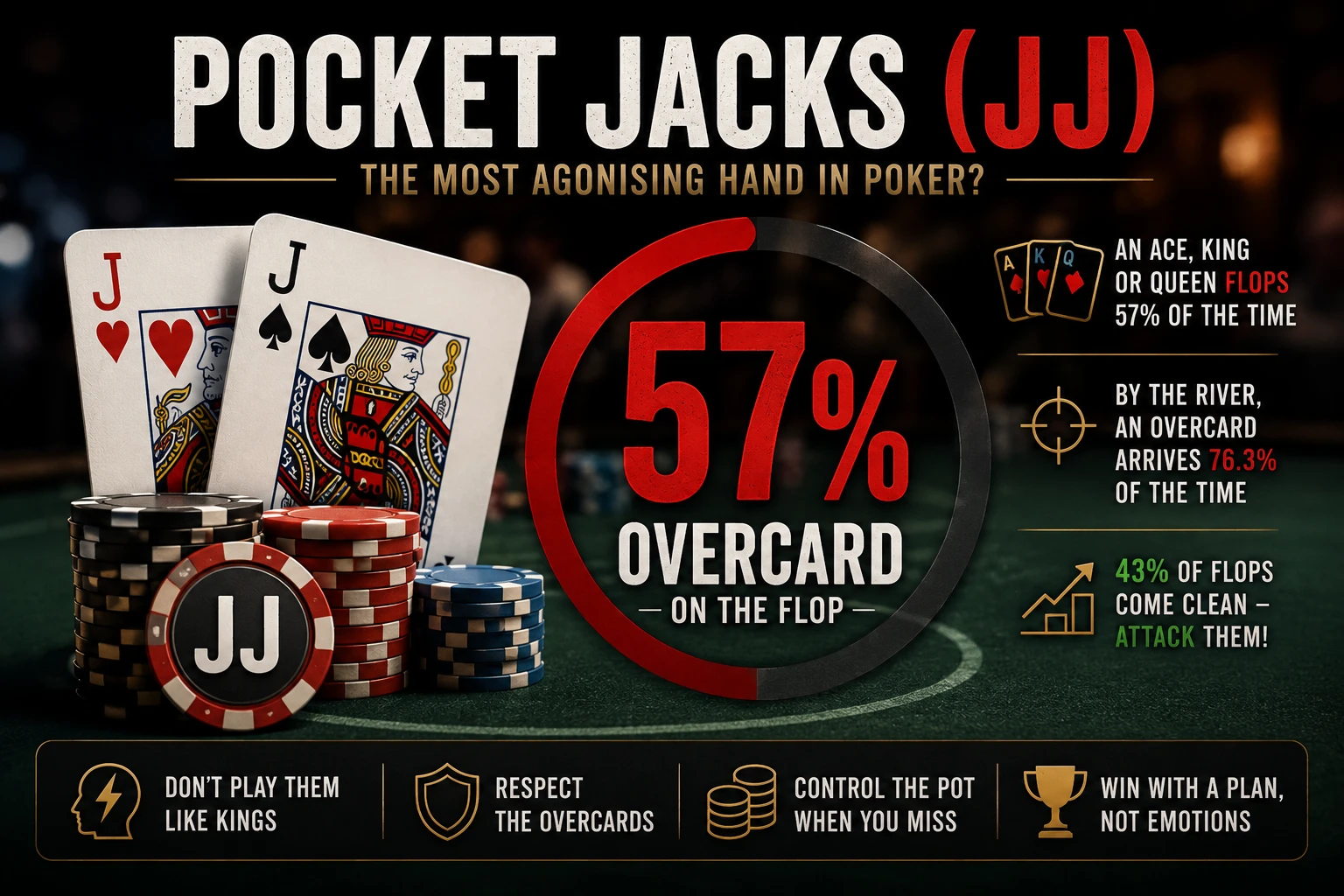
With pocket jacks, an ace, king or queen flops 57% of the time.
That is the whole hand. Jacks are the tipping point — the first premium pair that is more likely to be looking at an overcard than not. Kings face that problem 22.6% of the time. Queens, 41.4%. Jacks cross the line into "usually." Stop expecting jacks to behave like a big pair, and they get much easier to play. New here? See how to play Texas Hold'em or the full starting hands guide.
The Overcard Problem, in Sequence
Look at the progression across the big pairs. This is the single most useful table on this page:
| Your hand | Overcard on the flop | Overcard by the river |
|---|---|---|
| KK | 22.6% | 35.3% |
| 41.4% | 59.9% | |
| JJ | 57.0% | 76.3% |
By the river, an overcard has arrived more than three times in four. Jacks are not a hand you plan to show down unimproved on a big board. They are a hand you either win with quickly, improve, or get away from.
The good news is the flip side, and players forget it: 43% of flops come clean. On those, you hold a powerful overpair and should attack. The problem isn't jacks. The problem is playing all flops as if they were the same.
The Equity Reality
Exact figures, enumerated across every possible board:
| JJ against… | JJ equity |
|---|---|
| Ace-King offsuit | 57.3% |
| Ace-King suited | 53.9% |
| Pocket aces (AA) | 18.9% |
| Pocket kings (KK) | 18.5% |
| Pocket queens (QQ) | 18.0% |
The shape is the same as queens, one rung lower: a modest favourite against AK, and drawing to two outs against any bigger pair. Against a random hand, jacks are still a big favourite — they beat 80% of the deck. It's specifically the hands that keep raising that hurt them.
The 4-Bet Problem
Jacks face the same dilemma as queens, but worse. Against the classic tight 4-bet range — aces, kings, queens and ace-king:
| Their hand | Combos | Your equity |
|---|---|---|
| AA | 6 | 18.9% |
| KK | 6 | 18.5% |
| 6 | 18.0% | |
| AK suited | 4 | 53.9% |
| AK offsuit | 12 | 57.3% |
| Total | 34 | 36.3% |
Crushed 52.9% of the time. Flipping 47.1%. Ahead: never. Overall equity: 36.3% — worse than queens (40%), because there's one more pair above you.
The conclusion is blunt: against a genuinely tight 4-bet, jacks are a fold. Not a heroic, agonised fold — an easy, boring one. The money you save here pays for a lot of the pots you'll win with them elsewhere.
As always, the range decides. Against a loose, aggressive 4-better who shows up with AK, tens and bluffs, jacks are fine. Against the player who has 4-bet twice in three hours, let them go.
Playing Jacks Before the Flop
- First in: raise. Never limp. Jacks want fewer opponents and the initiative.
- Facing a raise: 3-bet in most spots, especially against late-position openers with wide ranges. Jacks play far better in a heads-up pot they built than in a multiway pot they called into. Against a very tight early-position raiser, calling to see a flop is reasonable.
- Facing a 3-bet: call more often than you 4-bet. 4-betting jacks tends to fold out everything you beat and get called only by what beats you — the worst possible outcome. Calling keeps their bluffs in the pot.
- Facing a 4-bet: fold against tight ranges, call against wide ones. See above.
- Short-stacked in a tournament: shove. All the agonising above requires deep stacks. With 20 big blinds or fewer, jacks are a clear get-it-in hand.
Playing Jacks After the Flop
Split the world in two, and the hand stops being scary:
Clean board, no overcard (43% of flops). You have a strong overpair. Bet it, build the pot, charge draws. This is where jacks make their money, and passivity here is the leak that funds everyone else's bad beats. Don't check "to keep them honest" — value-bet.
Overcard board (57% of flops). Your overpair has become a bluff-catcher. That does not mean fold immediately: a single continuation bet is often still correct, since your opponent misses most flops too. But the plan is pot control — keep the pot small, take a cheap showdown if you can, and be entirely willing to fold to sustained aggression. An underpair to the board is not a hand to stack off with, and refusing to accept that is why jacks have their reputation.
The mental shift that fixes jacks: treat them as a strong hand that frequently becomes a medium one. Players who lose stacks with jacks are the ones still playing them like kings on the turn. Position makes it far easier — see the position section.
Cash Games vs Tournaments
Cash (deep stacks): all the difficulty lives here. Deep money means overcard boards get expensive and the 4-bet fold genuinely matters. Reads and discipline do the work.
Tournaments: jacks are much simpler. Shallower stacks mean fewer post-flop decisions, wider ranges mean better equity, and fold equity is worth more than the last few points of showdown equity. Get them in and move on.
The Common Leaks
- Playing them like kings. Stacking off on A-K-4 because "I have jacks."
- Playing them like garbage. Folding to any raise and never realising their value on the 43% of clean flops.
- 4-betting them pre-flop. Folds out the hands you beat; gets called by the hands that beat you.
- Calling a tight player's 4-bet. Equity 36.3%. Just fold.
- Refusing to fire on clean boards. The passive line with an overpair on 9-6-2 leaves value on the table every time.
The Lineage: A Hand About Discipline
Jacks are the classic illustration of a principle that runs through all of poker's foundational literature: hand strength is relative, not absolute. David Sklansky's fundamental theorem asks you to play as though you could see your opponent's cards, and jacks are the hand where that question changes answer most often — the same two cards are a value-betting monster on one flop and a fold on the next. The mental-game tradition, Jared Tendler's work in particular, treats the "jacks tilt" pattern as a recognisable emotional leak rather than a strategic one: players don't lose with jacks because they don't know the maths, but because they refuse to accept it in the moment. Solver work confirms the boring conclusion — jacks call more than they 4-bet, and fold to genuine strength. Concept from the classics, precision from the solvers.
Quick Reference
- An overcard flops 57% of the time — and 76.3% by the river. Jacks are usually behind on a big board.
- But 43% of flops are clean. On those, attack. That's where the money is.
- Against a tight 4-bet: 36.3% equity, crushed 53% of the time. Fold.
- Prefer calling to 4-betting. 4-betting jacks folds out worse and gets called by better.
- Overcard board = bluff-catcher. Pot control, not stack-off.
- In tournaments: just get them in.
Frequently Asked Questions – Pocket Jacks
Why are pocket jacks so hard to play?
Because an ace, king or queen flops 57% of the time — more often than not. Jacks are the first premium pair that is usually looking at an overcard, which means the same hand that was a monster pre-flop is frequently just a bluff-catcher by the flop. Players who keep playing them like kings lose stacks.
Should you fold pocket jacks to a 4-bet?
Against a tight player, yes. Facing a range of aces, kings, queens and ace-king, jacks have about 36.3% equity and are crushed more than half the time. Against a loose, aggressive 4-better whose range includes AK, tens and bluffs, calling is fine.
Should you 4-bet with jacks?
Usually not. A 4-bet folds out the hands you're beating and gets called mainly by the hands that beat you. Calling a 3-bet keeps your opponent's bluffs in the pot, which is exactly where jacks make money.
JJ vs AK — who's ahead?
Jacks, narrowly. About 53.9% against AK suited and 57.3% against AK offsuit. It's the classic pair-versus-overcards race — jacks are the favourite, but it's close to a coinflip.
What do you do when an overcard flops?
Slow down, but don't panic. Your opponent misses most flops too, so a single continuation bet is often correct. The plan is pot control: keep the pot small, take a cheap showdown if you can, and fold to sustained aggression. Do not stack off with an underpair to the board.
Are pocket jacks a good hand?
Yes — they're a top-five starting hand and beat about 80% of the deck. They just require more post-flop discipline than any other premium pair, which is why they have a reputation for being difficult.
Where to Go Next
- Back to the starting hands guide for the full chart and framework.
- The hand one rung above, with the same problem: pocket queens.
- The pairs that crush jacks: pocket aces and pocket kings.
- New to the game? Start with how to play Texas Hold'em and the hand rankings.