
Small pocket pairs are the most misunderstood hands in poker, because the numbers seem to say one thing and the game says another. Look at this and tell me pocket fives are weak:
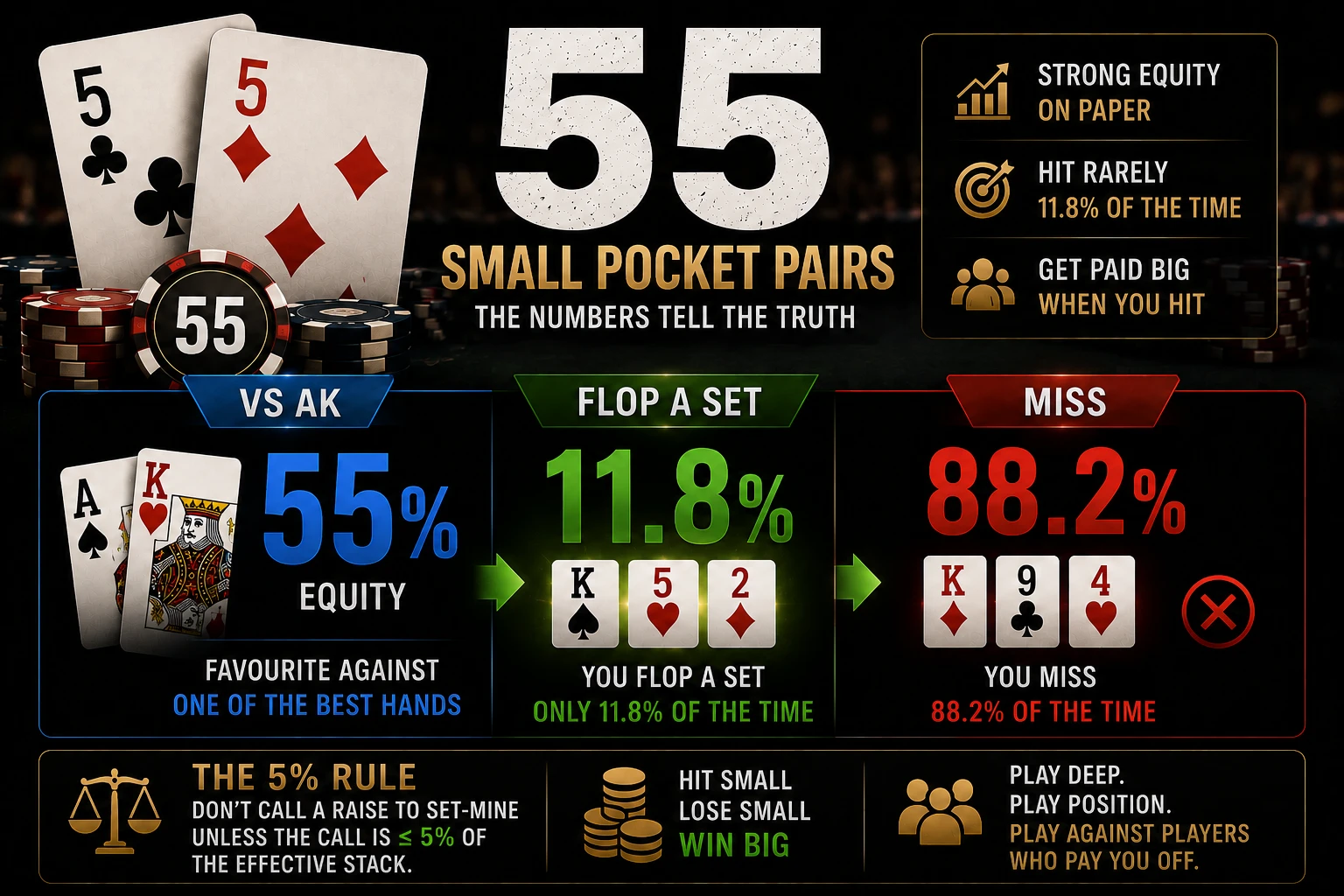
55 against AK offsuit: 55.0% equity. Against AK suited: 51.8%.
A pair of fives is a favourite against one of the best hands in poker. So why does everyone say small pairs are trouble? Because of this:
You flop a set 11.8% of the time. You miss 88.2% of the time.
The equity is real. Your ability to use it is not. That single sentence is the whole hand, and it's the most important idea on this page. New here? See how to play Texas Hold'em or the full starting hands guide.
Why Raw Equity Lies
That 55% figure only applies if all the money goes in before the flop and the hand runs to showdown. That happens rarely.
What actually happens is this: you call a raise, you see a flop, and 88% of the time it comes something like K-9-4. Now you hold an underpair to the board, out of position, against someone who raised. You can't call three streets. You can't bluff. You fold. You had 55% equity and you realised almost none of it.
This is the difference between raw equity (how often your cards win at showdown) and realised equity (how much of that you actually collect, given that you have to play the hand). Small pairs have great raw equity and terrible realised equity. Big cards are the reverse — AK misses the flop two-thirds of the time yet keeps fighting, because ace-high can still win and still bluff. Small pairs can't. An unimproved small pair is close to unplayable post-flop. So you stop trying to play it, and you play the 11.8% instead.
Set Mining: The Actual Strategy
Small pairs aren't value hands. They're lottery tickets with implied odds. The plan is simple:
- See a cheap flop.
- Hit a set (11.8%).
- Get paid an enormous amount.
- Otherwise, fold instantly and lose nothing more.
Step 4 is what makes it work, and it's the step beginners skip.
The maths: flopping a set is roughly 7.5 to 1 against. So you need to win about 8× your call on the times you hit, to break even on the times you don't.
Don't call a pre-flop raise to set-mine unless the call costs no more than about 5% of the effective stack. If your opponent has 100 big blinds behind and the raise is 3bb, that's 3% — a fine set-mine. If they have 25bb behind and the raise is 3bb, that's 12% — the money simply isn't there to win, and calling is a losing play.
Some players use a looser 10% threshold. The exact number matters less than the principle: the deeper the stacks, the better the set-mine. With short stacks, set-mining is a trap.
And it only works if they'll pay you. Implied odds are a promise, not a fact. A calling station or an aggressive player who can't fold an overpair will pay you off. A tight, observant player will fold to your raise on 7-7-2 and the 8× never arrives. Set-mine against people who pay, not against people who fold.
The Equity Reality
Exact figures, enumerated across every possible board:
| 55 against… | Equity |
|---|---|
| Ace-King offsuit | 55.0% |
| Ace-Queen offsuit | 54.7% |
| Ace-King suited | 51.8% |
| Pocket jacks (JJ) | 20.1% |
| Pocket aces (AA) | 18.5% |
The pattern: a small pair is a coinflip-or-better against any two overcards, and drawing to two outs against any bigger pair. That's why they're fine to get all-in with pre-flop in a tournament — and why they're miserable to play out of position for a hundred big blinds.
And the set-mine odds are identical for every small pair — a pocket 2 flops a set exactly as often as a pocket 6:
| Pocket pair | Flop a set | Set by the river |
|---|---|---|
| 22 | 11.8% | ~19.2% |
| 33 | 11.8% | ~19.2% |
| 44 | 11.8% | ~19.2% |
| 55 | 11.8% | ~19.2% |
| 66 | 11.8% | ~19.2% |
The rank only matters for the rare times your pair is itself an overpair to the flop, and for how often a bigger card pairs the board against you. For set-mining purposes, treat 22 through 66 as the same hand.
Why Professionals Love Small Pocket Pairs
Ask a winning player for a favourite hand to play deep-stacked, and small pairs come up more than you'd expect. The reason is pure asymmetry: they win rarely, but when they win, they win big. A set is one of the most disguised, most profitable hands in poker — nobody puts you on 3-3 when the flop is Q-8-3, so an opponent with top pair or an overpair pays you off in full.
That's the professional's edge in a sentence: small pairs are cheap to play and occasionally catastrophic for the opponent. You risk a small pre-flop call for a shot at someone's whole stack, and you throw the hand away instantly the 88% of the time it misses. Played with discipline — deep stacks, cheap price, opponents who pay — they're a quiet, low-variance profit engine that recreational players consistently misprice. The losing player sees a weak hand; the winning player sees a bargain-priced lottery ticket with a real jackpot.
Playing Small Pairs Before the Flop
- First in, late position: raise. You have initiative, position, and fold equity. This is the best way to play them.
- First in, early position: raise or fold, depending on the table. Never limp into a table that raises behind you — you'll be forced out or forced into a bad multiway spot.
- Facing a raise: call only if the set-mine maths works (5% rule, deep stacks, opponent who pays). Otherwise fold. This is the discipline that separates winning from losing players with these hands.
- Facing a 3-bet: fold. Almost always. The pot is now big relative to the stacks, and the implied odds are gone.
- Short-stacked in a tournament: shove. All the above requires deep stacks. With 15 big blinds, a small pair is a coinflip against overcards plus fold equity — a clear all-in.
Multiway is good for small pairs — the opposite of big pairs. More opponents means more people to pay you off when you hit your 11.8%. The crowd that destroys aces is exactly what set-mining wants.
Playing Small Pairs After the Flop
You hit your set (11.8%). This is a monster and it's beautifully disguised — nobody puts you on 5-5 when the flop is K-9-5. Get paid. Don't slow-play it into oblivion: bet, raise, build the pot. The one danger is a board that keeps running out straights and flushes, so charge draws rather than trapping.
You missed (88.2%). Fold. Really. A continuation bet as the pre-flop raiser is fine in position against one opponent, but if you called to set-mine and missed, your hand is done. The single biggest leak with small pairs is calling one more street "just in case" — those calls are exactly the money the 8× payout is supposed to cover.
The rare middle case: you flop an overpair (e.g. 66 on a 5-3-2 board). Playable, but treat it as a medium hand, not a monster. It's still just one pair, and it's small. Position makes all of this easier — see the position section.
Cash Games vs Tournaments
Cash (deep stacks): set-mining is at its best. Deep money is exactly what implied odds need, and one set against a stubborn overpair pays for a lot of folded flops.
Tournaments: set-mining largely dies. Stacks are too shallow for the 8× payout to exist, so small pairs become all-in hands instead — either shoving for fold equity or calling as a coinflip against overcards. Trying to set-mine with 25 big blinds is one of the most common tournament leaks there is.
The Common Leaks
- Calling raises with no implied odds. Short stacks, or an opponent who won't pay. The set-mine only works when the 8× actually exists.
- Not folding when you miss. 88.2% of the time you have nothing. Act like it.
- Overvaluing an unimproved pair. An underpair to the board is not a hand.
- Limping into raising tables. You end up in a bloated multiway pot with no initiative.
- Set-mining in tournaments with 25 big blinds. The money to win isn't there.
- Slow-playing a set into a wet board. You hit the 11.8% — collect it, don't get cute.
The Lineage: Implied Odds Are the Point
Small pairs are the purest expression of an idea David Sklansky formalised decades ago: a hand's value isn't only what it wins now, but what it can win later — implied odds. Sklansky's framework is exactly what tells you a 7.5-to-1 shot is a bargain when the payoff is 15-to-1 and a disaster when it's 3-to-1, and it's why the same pocket fives are a clear call against a deep-stacked calling station and a clear fold against a short-stacked nit. Modern solvers refine the thresholds and the exact ranges, but they don't dispute the concept — set-mining ranges widen with stack depth in every solution, for precisely the reason Sklansky gave. Concept from the classics, precision from the solvers.
Quick Reference
- You flop a set 11.8% of the time — 7.5 to 1 against. You need ~8× your call in implied winnings.
- The 5% rule: don't call to set-mine unless the call is ≤5% of the effective stack.
- Deeper stacks = better set-mine. Short stacks = shove instead.
- 55 has 55% against AK — but you only realise that equity all-in pre-flop, not post-flop.
- Multiway is good for small pairs — more people to pay you off.
- When you miss, fold. That's 88.2% of the time.
- Set-mine against people who pay, not people who fold.
Frequently Asked Questions – Small Pocket Pairs
What are the odds of flopping a set with a pocket pair?
About 11.8% — roughly 1 in 8.5, or 7.5 to 1 against. By the river, you'll have hit a set about 19.2% of the time, but the flop number is the one that matters, because that's when you decide whether to continue. The odds are identical for every pocket pair, from 22 to AA.
What is set mining?
Calling a pre-flop raise with a small pocket pair for the specific purpose of hitting a set on the flop and winning a big pot. You miss 88.2% of the time and fold immediately; the 11.8% has to pay for all of it — which is why it only works with deep stacks and opponents who'll pay you off.
What is the 5% rule in set mining?
Don't call a pre-flop raise to set-mine unless the call costs no more than about 5% of the effective stack. Since flopping a set is 7.5 to 1 against, you need to win roughly 8× your call when you hit — and that money has to actually be behind.
Are small pocket pairs good hands?
They're profitable hands played correctly and expensive ones played badly. All-in pre-flop they're a coinflip against overcards (55 has 55% against AK offsuit). Post-flop, unimproved, they're close to unplayable. Everything depends on whether you get to see a cheap flop with deep stacks behind.
Are pocket fives a favourite against AK?
Yes, narrowly — about 55.0% against AK offsuit and 51.8% against AK suited. Any pocket pair is a slight favourite (a "coinflip") against two overcards. The catch is that you only realise that edge if the money goes in pre-flop; post-flop, an unimproved pair usually can't stand the heat.
What's the difference between raw and realised equity?
Raw equity is how often your cards win at showdown if the hand runs out; realised equity is how much of that you actually collect, given you have to play the hand. Small pairs have high raw equity but low realised equity — they're a favourite on paper but often unplayable after a flop that misses them.
Should I set-mine in tournaments?
Usually not. Set-mining needs deep stacks so the 8× payout exists, and tournament stacks are typically too shallow. With 25 big blinds or fewer, small pairs become shoving hands rather than set-mining hands.
Should you limp with small pocket pairs?
Prefer raising when you're first in, especially from late position. Limping into a table that raises behind you leaves you in a bloated multiway pot with no initiative. Limping is only defensible in a very passive game where nobody raises and you can see cheap multiway flops to set-mine.
Why do I keep losing money with small pairs?
Almost always one of two things: calling raises when the implied odds aren't there (short stacks, or an opponent who folds), or failing to let go on the 88% of flops where you miss. The strategy only works if the folds are instant and free.
Is it better to have more opponents with a small pair?
For set-mining, yes — unlike big pairs, which collapse multiway. More opponents means more people to pay you off on the 11.8% of flops where you hit. Just make sure the price to see the flop stays cheap.
Do all pocket pairs flop a set at the same rate?
Yes — every pocket pair from 22 to AA flops a set exactly 11.8% of the time. The difference between small and big pairs is what happens when you don't flop a set: a big pair is often still the best hand, while a small pair usually isn't.
Where to Go Next
- Back to the starting hands guide for the full chart and framework.
- The big pairs that crush small ones: pocket aces and pocket kings.
- The overcards small pairs race against: Ace-King.
- New to the game? Start with how to play Texas Hold'em and the hand rankings.