
Ace-Queen is a strong hand, a clear raising hand, and one of the most reliable stack-losers in poker. It is nicknamed "the mistake hand" for a reason — not because it's weak, but because of what it runs into.
AQ is the hand that teaches domination, and it teaches it from both sides. Two numbers define it — nearly mirror images. AQ has just 26% equity against Ace-King offsuit, but 74.2% against King-Queen offsuit: the same gap in card rank, opposite side of the table. AQ crushes KQ for exactly the reason AK crushes AQ. New here? See how to play Texas Hold'em or the full starting hands guide.
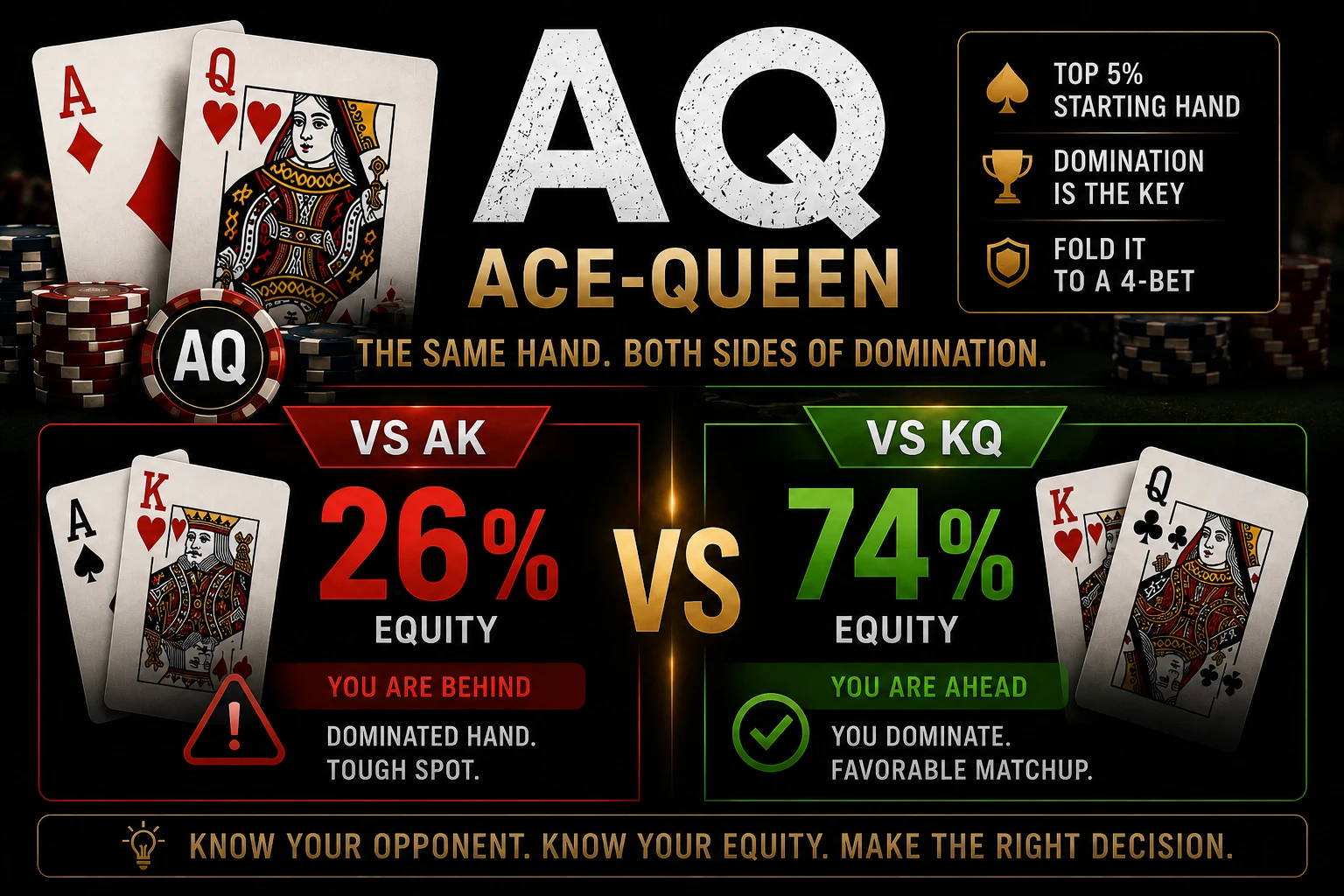
Domination: What It Actually Costs
Here is the fact that reframes the hand:
AQ has 46% equity against pocket jacks — a hand that beats it. It has 26% against AK — a hand that hasn't even made a pair.
Read that again. Jacks are ahead of you. AK is behind you. And yet you are far worse off against AK.
Being dominated is worse than being behind. When you hold AQ against AK, you share the ace. That means the card you're most likely to pair — the ace, your best card — is the very card that makes you lose. Pair the ace, and your opponent has the same pair with a better kicker. Your best outcome becomes your worst. You're effectively drawing to three queens and running boards.
Against jacks, nothing is shared. Any ace or queen wins the pot outright. That's why a hand that's technically behind gives you nearly twice the equity of a hand that's technically ahead. This is the single most valuable concept AQ can teach you, and it applies everywhere: a shared card is a trap. It's the reason Ace-King is so powerful — it does this to everyone else.
The Equity Reality
Exact figures, enumerated across every possible board:
| AQ against… | AQ equity |
|---|---|
| King-Queen offsuit | 74.2% (AQ dominates) |
| Ace-Jack offsuit | 75.1% (AQ dominates) |
| Pocket tens (TT) | 46.0% |
| Pocket jacks (JJ) | 46.0% |
| Pocket kings (KK) | 32.1% |
| Ace-King suited | 28.7% |
| Ace-King offsuit | 26.0% |
The pattern is unmistakable. Against pairs, AQ is a live underdog — a coinflip against jacks and tens, and even against kings it's not hopeless. Against ace-king it is crushed, worse than against any pair below aces. And notice: AQ dominates AJ and KQ by roughly the same margin AK dominates AQ. You are constantly on both ends of this.
The AQ Trap
The stack-loss pattern is always the same, and once you've seen it written down you'll recognise it at the table:
- You raise with AQ.
- Someone 3-bets.
- You call.
- The flop comes ace-high.
- You have top pair with a strong kicker. You feel great.
- You lose your stack.
The problem is step 2. A player who 3-bets and then commits chips to an ace-high board is holding AK far more often than they're holding AJ. Top pair with a queen kicker is a beautiful hand right up until it's the second-best version of itself.
The fix isn't to fold AQ. It's to recognise which flops are dangerous. An ace-high board is not a green light with AQ — it's the exact board where you get paid off by nothing and pay off everything. Ironically, a queen-high board is much safer: fewer players hold a queen, and the hands that beat you are rarer.
When AQ Makes Money
It's easy to finish the sections above thinking AQ is a hand to fear. It isn't — it's a hand that makes real money, just not against the range it fears. AQ profits by being the dominating hand far more often than the dominated one. Remember the equity table: AQ crushes AJ (75%), AT, KQ (74%) and every weaker ace, by the same brutal margin AK uses on AQ.
So where does the money come from? Wide ranges. Against a loose button opener, a blind defending with a broad range, or a recreational player who plays any ace and any two Broadway cards, AQ is a machine — it dominates the exact hands they love. The ace-high board that traps you against AK is the same board that traps them against you when they hold AJ or A-rag. You are the AK in that pot.
The lesson is symmetry: fear AQ against tight, aggressive ranges; print money with it against wide, loose ones. Raise it freely, isolate limpers, punish wide blinds — and save your caution for the rare spots where the money going in screams AK.
Playing AQ Before the Flop
AQ is a raising hand, not a calling hand — but it's the first strong hand that has to fold sometimes.
- First in: raise, from any position. AQ is comfortably in the top 5% of hands.
- Facing a raise: 3-bet against late-position openers with wide ranges. Against a tight early-position raiser, calling is fine — their range contains AK, and 3-betting into it just builds a pot you're 26% in.
- Facing a 3-bet: this is where AQ starts hurting. Against aggressive 3-betters, call. Against tight ones, AQ offsuit is often a fold — their 3-betting range is heavy with the exact hands that crush you (AK, AA, KK, QQ).
- Facing a 4-bet: fold AQ offsuit. Almost always. A 4-betting range is aces, kings, queens and ace-king — you are crushed by all of them and beat none. AQ suited can occasionally continue against wide 4-betters, but the default is to let it go.
The discipline: AQ raises freely and folds to real strength. Players who treat it as an unfoldable premium hand are the ones funding everyone else.
Suited vs Offsuit
With AQ the suited/offsuit split matters more than with almost any other strong hand — because the very spots where AQ is dominated are the spots where a flush changes everything.
AQ suited is a genuinely top-tier hand, playable almost anywhere. The extra value isn't just the raw equity bump (28.7% against AK suited versus 26.0% offsuit) — it's playability and escape routes:
- Flush and nut-flush potential. When you flop the ace-high flush draw, you hold the nut draw — even against AK you have massive equity and can barrel with a clear conscience.
- Semi-bluffing. A flush draw lets you keep betting on boards where offsuit AQ has to check and give up. You apply pressure with a hand that can win two ways: fold equity now, and the flush later.
- Reverse implied odds, reduced. This is the hidden killer with AQ offsuit: on an ace-high board you make top pair and then lose a big pot to AK — that's a reverse-implied-odds disaster. Suited AQ escapes more of those because it can win with a flush and fold its one pair more comfortably.
- Blockers. Holding an ace blocks half the AA and AK combinations your opponent could have, which nudges the ranges you face slightly in your favour when you decide to continue.
AQ offsuit is still strong — a clear raise everywhere — but noticeably more fragile. It has no flush to bail it out of the dominated spots, so it's the version that folds to 4-bets and to tight 3-betters, and the version that most needs the discipline to let go of top-pair-queen-kicker on a dangerous board. In short: same two ranks, two different hands. Treat suited AQ as a hand you can push with, and offsuit AQ as a hand you raise and then respect the brakes on.
Playing AQ After the Flop
- Queen-high board: you're in good shape. Top pair with the best kicker, and the hands that beat you (kings, aces, sets) are relatively rare. Bet for value.
- Ace-high board: proceed carefully, especially against aggression from anyone who showed pre-flop strength. Value-bet against weak players and wide ranges; slow down against a player representing AK. This is the board where AQ loses stacks.
- Missed board: you have two overcards, often with backdoor equity. Continuation-bet as the pre-flop raiser, and be willing to give up. Ace-high is a bluff-catcher, not a stack-off.
As always, position makes every one of these decisions easier — see the position section.
Cash Games vs Tournaments
Cash (deep stacks): domination is at its most expensive. Deep money means the ace-high board can cost you 100+ big blinds. The AQ folds matter here, and they're the difference between a winning and a losing player at mid-stakes.
Tournaments: AQ improves substantially. Wider shoving and calling ranges mean you run into AK far less often relative to everything else, and fold equity is worth a lot. Short-stacked, AQ is a comfortable shove and a fine call against most ranges.
The Common Leaks
- Treating AQ as unfoldable. It is not AK. It folds to 4-bets and to tight 3-betters.
- Stacking off on ace-high boards. The classic. Top pair, queen kicker, second-best.
- 3-betting into tight early-position raisers. Their range is exactly what crushes you.
- Playing AQ offsuit like AQ suited. The suited version continues in spots the offsuit version shouldn't.
- Folding it too much after being burned. AQ dominates AJ, AT and KQ, and beats most of the deck. Don't overcorrect.
The Lineage: Domination Is an Old Idea
The concept of domination — that a shared card turns your strongest outcome into your worst — runs straight through David Sklansky's foundational work on hand values and remains one of the few ideas from the pre-solver era that needed no revision at all. Doyle Brunson's aggressive school supplies the default (raise it, don't limp it), but the modern refinement is entirely about restraint: solver ranges fold AQ offsuit to 4-bets without hesitation, precisely because the equity math is brutal and no amount of aggression changes it. AQ is where poker's classic wisdom and its modern computation say exactly the same thing: know what your opponent's aggression represents, because your best card might be your worst. Concept from the classics, precision from the solvers.
Quick Reference
- AQ has 26% against AK — and 46% against jacks. Domination is worse than being behind.
- AQ dominates AJ (75%) and KQ (74%) just as thoroughly as AK dominates AQ — that's where its money comes from.
- Raise it freely. Fold it to 4-bets. It is not a premium hand in the unfoldable sense.
- The ace-high board is the trap. A queen-high board is safer.
- Suited and offsuit are different hands. The offsuit version folds more; the suited version can push.
Frequently Asked Questions – Ace-Queen
Is Ace-Queen a good hand?
Yes — it's a top-5% starting hand and a clear raise from any position. It dominates AJ, AT and KQ, and beats most of the deck. Its weakness is specific: it's crushed by AK, and that one matchup is where most of the money is lost.
AQ vs AK — what are the odds?
AQ has about 26.0% equity against AK offsuit and 28.7% against AK suited. That's worse than AQ fares against pocket jacks (46%), even though jacks are ahead and AK isn't. Domination is worse than being behind.
What does "dominated" mean in poker?
It means you share a card with your opponent and hold the weaker second card. With AQ against AK, both of you hold an ace — so when the ace pairs, you make top pair and still lose to their better kicker. Your best card becomes the card that beats you.
Should you fold Ace-Queen pre-flop?
Yes, sometimes. Against a 4-bet, AQ offsuit is a fold in almost all cases — a 4-betting range consists of aces, kings, queens and ace-king, and you're crushed by every one of them. Against a tight player's 3-bet, folding is also often correct.
Why do I keep losing with AQ?
Almost certainly the ace-high board. You flop top pair with a queen kicker, feel strong, and pay off an opponent holding AK. The hand isn't bad — the board that looks best for it is the one where it's most often second-best.
Is AQ suited much better than AQ offsuit?
Slightly better in raw equity, and meaningfully better in playability. The flush potential creates escape routes, nut-flush draws and semi-bluffs, and lets it continue in spots where the offsuit version should fold. Treat them as two different hands.
Should you shove AQ all-in?
Short-stacked in a tournament (roughly 20 big blinds or fewer), yes — AQ is a comfortable shove and a fine call against most ranges, since fold equity and wide calling ranges outweigh the AK problem. Deep-stacked, prefer raising and be ready to fold to a 4-bet rather than getting it all in.
AQ vs QQ — what are the odds?
You're a clear underdog — roughly 29–30% equity. Queens dominate your queen and are already a made pair, so you're mostly drawing to an ace. It's not as bad as AQ vs AK, but it's not a spot to commit a big pot in lightly.
AQ vs JJ or TT — who's ahead?
It's essentially a coinflip: AQ has about 46% against either pocket jacks or pocket tens. Two overcards against a pair is the classic race, and here the pair is a very slight favourite.
How should you play AQ from early position (UTG)?
Raise — AQ is strong enough to open from any seat. Just be more willing to fold it to heavy aggression from up front, since an early-position pot that gets 3-bet is more likely to contain the hands (AK, big pairs) that dominate you.
How should you play AQ on the button?
The button is where AQ shines. You can raise to isolate limpers, 3-bet wide openers, and play every flop in position — and you're dominating the wide range the blinds defend with. This is where AQ makes much of its money.
Is AQ good in tournaments?
Yes, and better than in cash games. Shorter stacks and wider ranges mean you run into AK far less often relative to everything else, and fold equity is worth a lot. AQ is a strong shoving and re-shoving hand once stacks get shallow.
Where to Go Next
- Back to the starting hands guide for the full chart and framework.
- The hand that dominates AQ: Ace-King.
- The pairs AQ races against: pocket jacks and pocket queens.
- New to the game? Start with how to play Texas Hold'em and the hand rankings.