Suited connectors — hands like 7♠6♠, 9♥8♥, J♦10♦ — are the most glamorous hands in poker and the most frequently overplayed. They're the hands people remember winning huge pots with, which is exactly why they lose money with them.
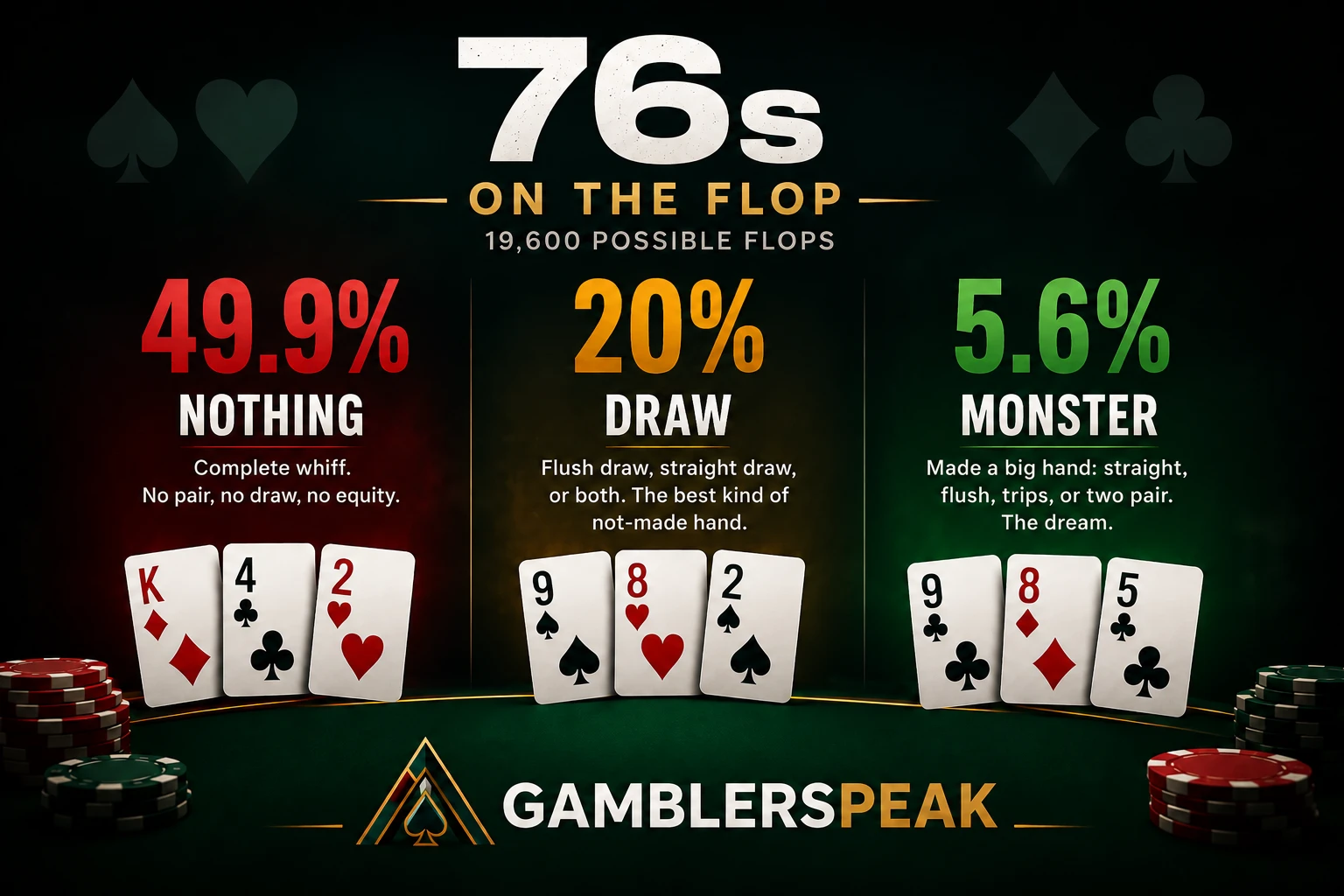
Here is what a suited connector actually does on the flop. These are all 19,600 possible flops for 7♠6♠:
| What you flop | How often |
|---|---|
| A big hand (flush, straight, trips, two pair) | 5.6% |
| A flush draw | 10.9% |
| An open-ended straight draw | 9.1% |
| A pair or better | 32.4% |
| Complete whiff — nothing at all | 49.9% |
Half the time you have nothing. And the dream — the flopped flush, the flopped straight — arrives once in eighteen flops. So why play them at all? Because of the two middle rows. New here? See how to play Texas Hold'em or the full starting hands guide.
The Key Difference From Small Pairs
Compare the two implied-odds hands side by side:
| Small pairs (55) | Suited connectors (76s) | |
|---|---|---|
| Flops a big hand | 11.8% (a set) | 5.6% |
| Flops a draw | — | 20.0% |
| Complete whiff | 88.2% | 49.9% |
A small pair hits its set or it's garbage. It is binary: monster or muck. There is no third state, which is why the strategy is so mechanical — see a cheap flop, hit or fold.
Suited connectors flop a draw one time in five. And a draw is not a dead hand — a draw is a weapon.
With a flush draw you can bet. You can raise. If your opponent folds, you win the pot without ever making the flush. If they call, you still have roughly a 35% chance to get there by the river. That combination — fold equity plus real equity — is the semi-bluff, and it's the entire reason suited connectors have value that small pairs don't.
Small pairs win by hitting. Suited connectors win by applying pressure. That single distinction changes how you play them, where you play them from, and against whom.
The Equity Reality
Exact figures, enumerated across every possible board:
| 76s against… | Equity |
|---|---|
| Ace-King offsuit | 42.3% |
| Pocket aces (AA) | 21.9% |
| Pocket kings (KK) | 21.9% |
Two things worth noting. First, 22% against aces is surprisingly live — better than a small pair manages (18.5%), because the suitedness and connectedness give you more ways to get there. Second, 42% against AK means you're never drawing dead against big cards; you just can't get all the money in profitably.
But as with small pairs, raw equity is not the point. You will not be shoving 76s pre-flop for value. That 22% figure matters only as reassurance that you're never crushed. The money comes from post-flop play.
Why Position Is Everything
This is the non-negotiable rule, and it separates suited connectors from every other hand type:
Suited connectors are a late-position hand. Out of position, they lose money.
The reason follows directly from the numbers. Half your flops are whiffs and a fifth are draws — hands whose value depends entirely on your ability to control the pot and apply pressure. You cannot do either from out of position:
- Out of position, you check, they bet, and you're guessing.
- In position, you see their action first, you can check back your draws for free cards, you can bet when they show weakness, and you can size the pot to fit your equity.
A small pair can be set-mined from anywhere — it plays itself. A suited connector needs you to play it, and you can only do that with position. (More on why in the position section.)
Playing Suited Connectors Before the Flop
- Late position, first in: raise. This is their home. You have initiative, position, and fold equity.
- Early position: fold most of them. Yes, even the pretty ones. Playing 7-6 suited from under the gun means playing a marginal hand out of position for the rest of the hand.
- Facing a raise: call in position, with deep stacks, against opponents who pay off. The same implied-odds logic as set-mining — the payoff has to actually exist. Out of position, fold.
- Facing a 3-bet: fold. The pot is bloated, the stacks are shallower relative to it, and the implied odds are gone.
- Multiway: good, as long as it's cheap. More opponents means more people to pay off your flush.
- Short-stacked in a tournament: these are not shoving hands for value — they're at best a coinflip-ish spot. Their whole value is post-flop, and short stacks have no post-flop. Play tighter with them as stacks shrink.
The suited part matters more than the connected part. A suited ace or a suited connector both derive most of their extra value from the flush. Offsuit connectors (7♥6♦) are not the same hand — drop them.
Playing Suited Connectors After the Flop
You flop a big hand (5.6%). Get paid. And note the disguise: your value comes precisely because nobody puts you on 7-6 when the board is 9-8-5. This is the hand you were playing for.
You flop a draw (20%). This is the real skill. Semi-bluff: bet or raise. You win two ways — they fold now, or you hit later. Do not just call and hope; passive draw-chasing is a losing strategy. As the aggressor you get folds and you get your equity. Charge draws when you have the made hand; bet draws when you have them.
You flop a pair (32.4%). Careful. A pair of sevens on a K-9-7 board is a weak made hand, not a monster. Pot control, take a cheap showdown, and don't build a big pot with a small pair and a bad kicker. This is where suited connectors quietly bleed money.
You whiff (49.9%). Fold, or make one continuation bet in position and give up. Half the time, that's the hand.
The Big Warning: They Are Not Premium Hands
The reason suited connectors have a reputation is survivorship bias. You remember the flopped straight that stacked someone. You don't remember the forty times you called a raise, missed, and folded. Those forty hands are where the money went.
The professionals who make money with suited connectors do so under strict conditions: in position, deep-stacked, against opponents who pay off, for a cheap price. Remove any one of those and the hand stops being profitable. The recreational player who plays them from every seat, calls raises out of position, and chases draws to the river with the wrong odds is not playing the same hand at all.
The Common Leaks
- Playing them out of position. The single biggest one. They need position to realise their equity.
- Calling raises with no implied odds. Short stacks or tight opponents = no payoff = losing call.
- Chasing draws passively. Calling down with a flush draw instead of semi-bluffing forfeits your fold equity.
- Overplaying weak pairs. A pair of sixes with a bad kicker is not a hand to stack off with.
- Playing offsuit connectors. 7♥6♦ is not a suited connector. It's a fold.
- Playing them like premium hands because you once won a huge pot with one.
The Lineage: Implied Odds, With Fold Equity Attached
The classical case for suited connectors is David Sklansky's implied-odds argument — the same one that justifies set-mining: a hand is worth what it can win later, not only what it wins now. But suited connectors add a second source of profit that small pairs lack, and it's one Doyle Brunson's aggressive school understood instinctively long before anyone quantified it: a draw lets you bet. The semi-bluff — betting a hand that can win by folding them out or by improving — is one of poker's oldest and most durable weapons, and suited connectors are its natural home. Modern solvers put numbers on it and confirm the shape: these hands appear far more often in raising and semi-bluffing ranges than in calling ranges, and they collapse to folds out of position. Concept from the classics, precision from the solvers.
Quick Reference
- They flop a big hand only 5.6% of the time and whiff completely half the time.
- But they flop a draw 20% of the time — and a draw is a weapon, not a dead hand.
- Small pairs win by hitting. Suited connectors win by applying pressure.
- Position is non-negotiable. Out of position, they lose money.
- Deep stacks, cheap price, opponents who pay. Remove any one and they stop being profitable.
- 22% against aces — never crushed, but never a shoving hand for value either.
- Offsuit connectors are not the same hand. Fold them.
Frequently Asked Questions – Suited Connectors
What are suited connectors?
Two cards of the same suit that are adjacent in rank — 7♠6♠, 9♥8♥, J♦10♦. They can make both straights and flushes, which gives them their appeal, and they're most valuable in late position with deep stacks.
How often do suited connectors flop a big hand?
Only about 5.6% of the time — that's a flush, straight, trips or two pair. They whiff completely on roughly half of all flops. The dream flop is rare, which is why they're a losing hand when overplayed.
Why play suited connectors if they miss so often?
Because 20% of the time they flop a draw — a flush draw or an open-ended straight draw. A draw lets you semi-bluff: you can win the pot immediately when your opponent folds, or by hitting later. That fold equity, plus the huge disguised pots when you connect, is where the profit lives.
Should I play suited connectors out of position?
No. This is the most important rule for the hand. Their value depends on controlling the pot and applying pressure, and you can't do either out of position. From early position, fold them.
Suited connectors vs pocket pairs — which is better?
Different, not better. A small pair is binary: it hits a set 11.8% of the time or it's worthless. A suited connector hits big less often (5.6%) but flops a playable draw 20% of the time, which makes it a semi-bluffing weapon. Pairs win by hitting; connectors win by applying pressure.
How do suited connectors do against aces?
About 21.9% — surprisingly live, and better than a small pair (18.5%) manages. But this figure is reassurance, not strategy: you're not shoving 76s pre-flop for value. Their money comes from post-flop play in the right spots.
Are offsuit connectors playable?
Rarely, and never for the same reasons. Removing the flush potential strips out most of the hand's equity and most of its semi-bluffing power. If it isn't suited, fold it.
Where to Go Next
- Back to the starting hands guide for the full chart and framework.
- The other implied-odds hand, and its opposite: small pocket pairs.
- The premium hands you're up against: pocket aces and Ace-King.
- New to the game? Start with how to play Texas Hold'em and the hand rankings.